







Question: Consider the following C program. Assume that the register SP at the beginning points to Ox0E00. Answer the following questions. Assume all variables are allocated


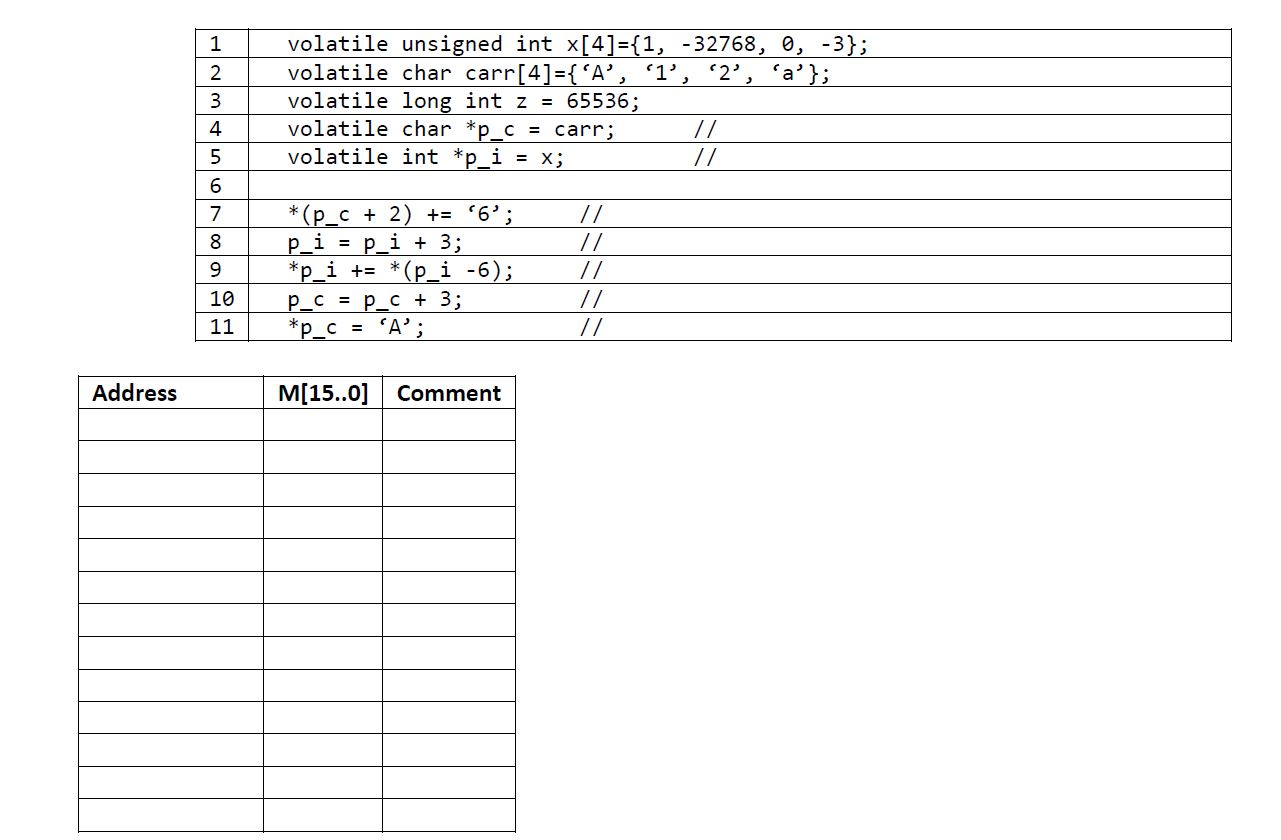
Consider the following C program. Assume that the register SP at the beginning points to Ox0E00. Answer the following questions. Assume all variables are allocated on the stack, and in the order as they appear in the program. B. (10 points) Comment the code (lines 7 11) indicating the result of each statement. Illustrate the content of the stack at the end of execution of the statement in line 11. What are the contents of arrays x and carr? volatile unsigned int x[4]={1, -32768, 0, -3}; volatile char carr[4]={'A', '1', '2', 'a'}; volatile long int z = 65536; volatile char *p_c = carr; // volatile int *p_i = x; 17 | *(p_C + 2) += 6'; p_i = p i + 3; *p_i += *(p_i -6); P_C = P_C + 3; *p_c = 'A'; // // // 11 Address M[15..0] Comment Consider the following C program. Assume that the register SP at the beginning points to Ox0E00. Answer the following questions. Assume all variables are allocated on the stack, and in the order as they appear in the program. B. (10 points) Comment the code (lines 7 11) indicating the result of each statement. Illustrate the content of the stack at the end of execution of the statement in line 11. What are the contents of arrays x and carr? volatile unsigned int x[4]={1, -32768, 0, -3}; volatile char carr[4]={'A', '1', '2', 'a'}; volatile long int z = 65536; volatile char *p_c = carr; // volatile int *p_i = x; 17 | *(p_C + 2) += 6'; p_i = p i + 3; *p_i += *(p_i -6); P_C = P_C + 3; *p_c = 'A'; // // // 11 Address M[15..0] Comment
Step by Step Solution
There are 3 Steps involved in it

Get step-by-step solutions from verified subject matter experts
 Study Help