







Question: Consider the following C++ program: #include using namespace std; int main() { struct foo_t { int x[100]; int var1; int y[10]; } foo; int var2;
Consider the following C++ program: #include using namespace std; int main() { struct foo_t { int x[100]; int var1; int y[10]; } foo; int var2; long i; int *p, *q; short int *s; long int *l; struct foo_t bar[50]; for (i=0; i
Do ONLY question 3, 4, 6,8
![struct foo_t { int x[100]; int var1; int y[10]; } foo; int](https://dsd5zvtm8ll6.cloudfront.net/si.experts.images/questions/2024/09/66f4e5eda73ed_67766f4e5ed45952.jpg)
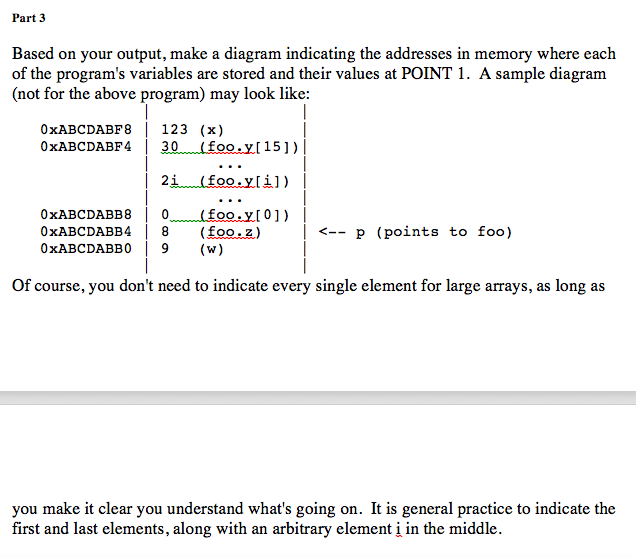
Part 3 Based on your output, make a diagram indicating the addresses in memory where each of the program's variables are stored and their values at POINT 1. A sample diagram (not for the above program) may look like: 0xABCDABF430foo.y[15]) 0xABCDABB80foo.yI0]) I 0xABCDABB4 8 (foo.z)
Step by Step Solution
There are 3 Steps involved in it
1 Expert Approved Answer
Step: 1 Unlock

Question Has Been Solved by an Expert!
Get step-by-step solutions from verified subject matter experts
Step: 2 Unlock
Step: 3 Unlock
 Study Help