







Question: Consider the following C++ program: int count = void red() { count +=1 void blue (funR) { int count = funR() print blue, count void
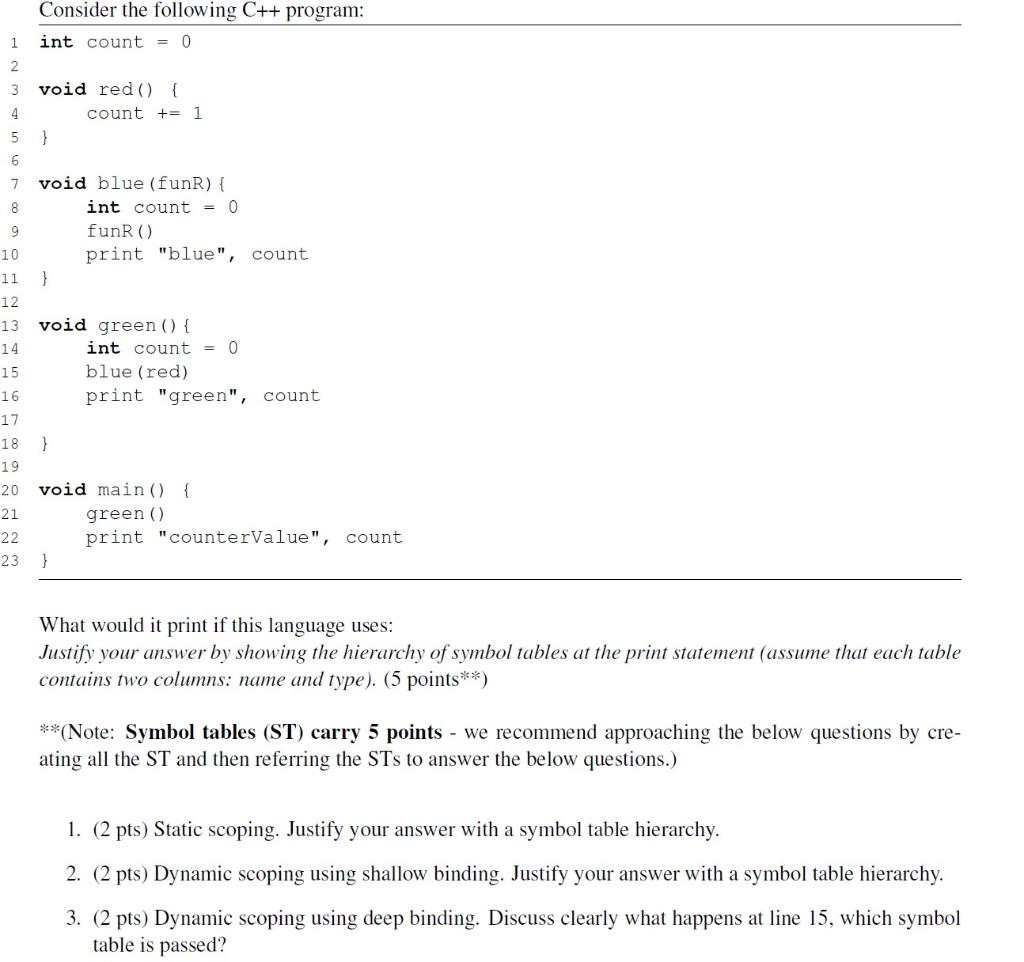
Consider the following C++ program: int count = void red() \{ count +=1 void blue (funR) \{ int count = funR() print "blue", count void green() \{ int count = 0 blue(red) print "green", count \} void main() \{ green() print "countervalue", count \} What would it print if this language uses: Justify your answer by showing the hierarchy of symbol tables at the print statement (assume that each table contains two columns: name and type). (5 points**) **(Note: Symbol tables (ST) carry 5 points - we recommend approaching the below questions by creating all the ST and then referring the STs to answer the below questions.) 1. (2 pts) Static scoping. Justify your answer with a symbol table hierarchy. 2. (2 pts) Dynamic scoping using shallow binding. Justify your answer with a symbol table hierarchy. 3. (2 pts) Dynamic scoping using deep binding. Discuss clearly what happens at line 15 , which symbol table is passed
Step by Step Solution
There are 3 Steps involved in it

Get step-by-step solutions from verified subject matter experts
 Study Help