







Question: Consider the following causal model containing random variables (L, R, B, T}, with dom(T) = {high, low}, dom(B) = {many, few), and all other
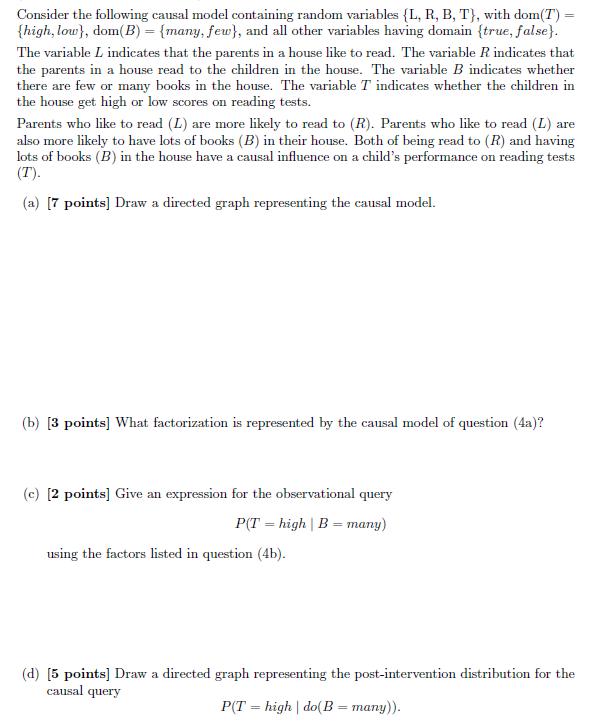
Consider the following causal model containing random variables (L, R, B, T}, with dom(T) = {high, low}, dom(B) = {many, few), and all other variables having domain {true, false}. The variable L indicates that the parents in a house like to read. The variable R indicates that the parents in a house read to the children in the house. The variable B indicates whether there are few or many books in the house. The variable T indicates whether the children in the house get high or low scores on reading tests. Parents who like to read (L) are more likely to read to (R). Parents who like to read (L) are also more likely to have lots of books (B) in their house. Both of being read to (R) and having lots of books (B) in the house have a causal influence on a child's performance on reading tests (T). (a) [7 points] Draw a directed graph representing the causal model. (b) [3 points] What factorization is represented by the causal model of question (4a)? (c) [2 points] Give an expression for the observational query P(Thigh | B = many) using the factors listed in question (4b). (d) [5 points] Draw a directed graph representing the post-intervention distribution for the causal query P(Thigh | do(B = many)).
Step by Step Solution
3.44 Rating (157 Votes )
There are 3 Steps involved in it
SOLUTION a Here is the directed graph representing the causal model L R L B R T B ... View full answer

Get step-by-step solutions from verified subject matter experts
 Study Help