







Question: Consider the following code: char c='a'; int i= 15; int j = 0; int main (void) { char c= 'b'; } int i 25;
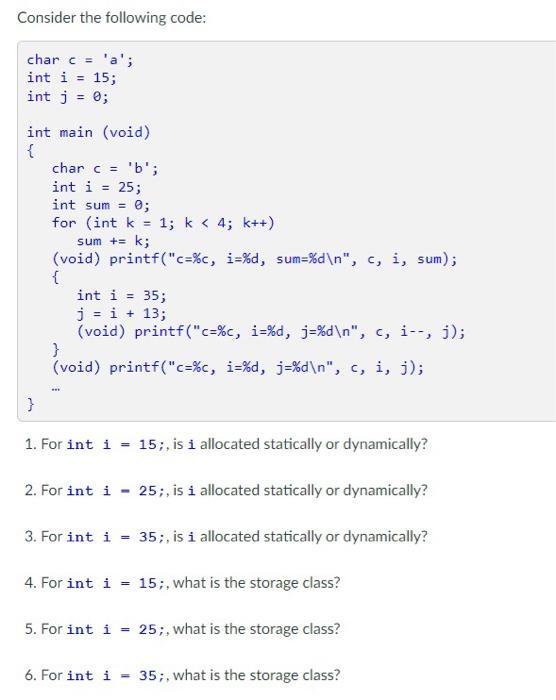
Consider the following code: char c='a'; int i= 15; int j = 0; int main (void) { char c= 'b'; } int i 25; int sum = 0; for (int k = sum += k; 1; k < 4; k++) (void) printf("c=%c, i-%d, sum-%d ", c, i, sum); { int i = 35; j = i + 13; (void) printf("c=%c, i=%d, j=%d ", c, i--, j); (void) (void) printf("c=%c, i=%d, j=%d ", c, i, j); 1. For int i = 15;, is i allocated statically or dynamically? 2. For int i = 25;, is i allocated statically or dynamically? 3. For int i = 35;, is i allocated statically or dynamically? 4. For int i = 15;, what is the storage class? 5. For int i = 25;, what is the storage class? 6. For int i 35;, what is the storage class?
Step by Step Solution
There are 3 Steps involved in it
Lets analyze the code snippet c char c prime a int i 15 int j 0 int mainvoid char c prime ... View full answer

Get step-by-step solutions from verified subject matter experts
 Study Help