







Question: Consider the following code implementing an immutable linked list (from assignment #1): public interface Immutablelist { public int numEvens(); } public class Cons implements Immutablelist
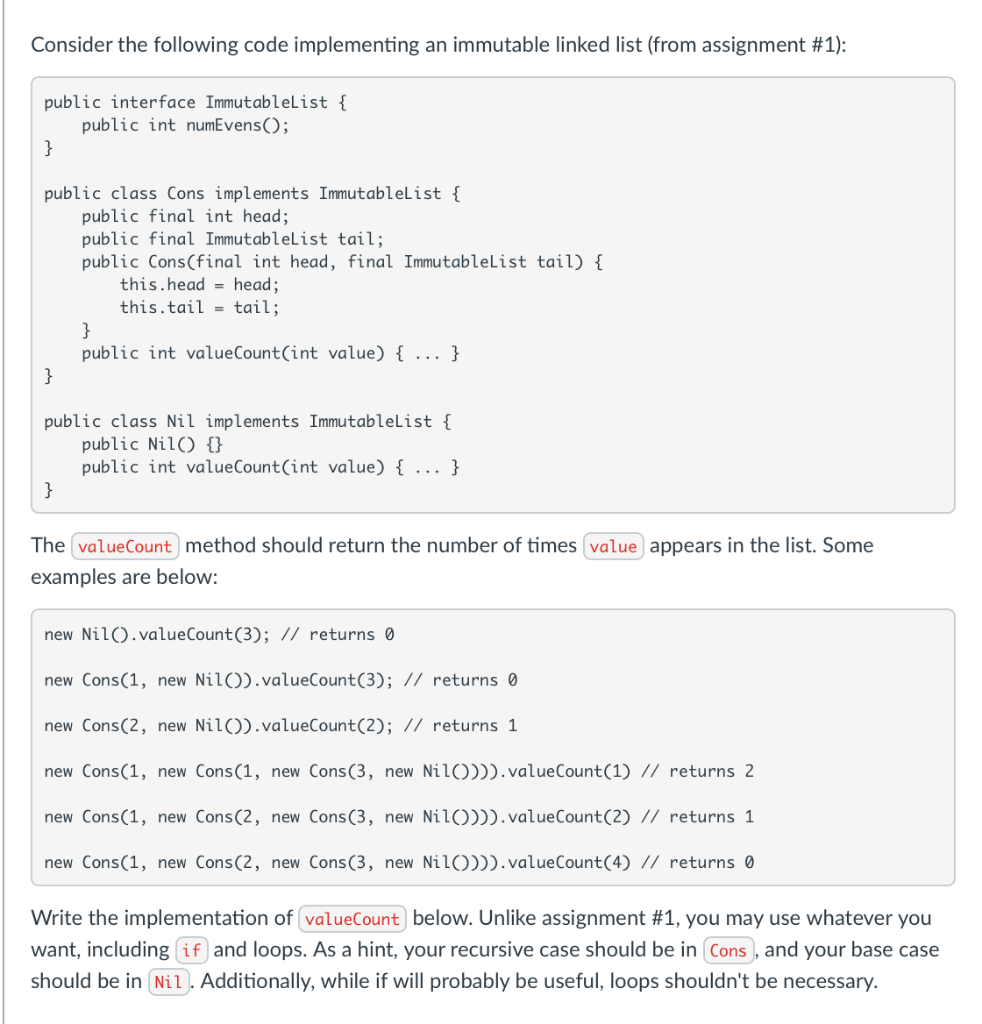
Consider the following code implementing an immutable linked list (from assignment #1): public interface Immutablelist { public int numEvens(); } public class Cons implements Immutablelist { public final int head; public final Immutablelist tail; public Cons(final int head, final Immutablelist tail) { this.head = head; this.tail = tail; } public int valueCount(int value) {...} } public class Nil implements ImmutableList { public Nil() {} public int valueCount(int value) { ... } } The valueCount method should return the number of times value appears in the list. Some examples are below: new Nil().valueCount(3); // returns 0 new Cons(1, new Nil()).valueCount(3); // returns 0 new Cons(2, new Nil()).valueCount(2); // returns 1 new Cons(1, new Cons(1, new Cons(3, new Nil()))).valueCount(1) // returns 2 new Cons(1, new Cons(2, new Cons(3, new Nil()))).valueCount(2) // returns 1 new Cons(1, new Cons(2, new Cons(3, new Nil()))).valueCount(4) // returns 0 Write the implementation of valueCount below. Unlike assignment #1, you may use whatever you want, including if and loops. As a hint, your recursive case should be in Cons, and your base case should be in Nil. Additionally, while if will probably be useful, loops shouldn't be necessary. Consider the following code implementing an immutable linked list (from assignment #1): public interface Immutablelist { public int numEvens(); } public class Cons implements Immutablelist { public final int head; public final Immutablelist tail; public Cons(final int head, final Immutablelist tail) { this.head = head; this.tail = tail; } public int valueCount(int value) {...} } public class Nil implements ImmutableList { public Nil() {} public int valueCount(int value) { ... } } The valueCount method should return the number of times value appears in the list. Some examples are below: new Nil().valueCount(3); // returns 0 new Cons(1, new Nil()).valueCount(3); // returns 0 new Cons(2, new Nil()).valueCount(2); // returns 1 new Cons(1, new Cons(1, new Cons(3, new Nil()))).valueCount(1) // returns 2 new Cons(1, new Cons(2, new Cons(3, new Nil()))).valueCount(2) // returns 1 new Cons(1, new Cons(2, new Cons(3, new Nil()))).valueCount(4) // returns 0 Write the implementation of valueCount below. Unlike assignment #1, you may use whatever you want, including if and loops. As a hint, your recursive case should be in Cons, and your base case should be in Nil. Additionally, while if will probably be useful, loops shouldn't be necessary
Step by Step Solution
There are 3 Steps involved in it

Get step-by-step solutions from verified subject matter experts
 Study Help