







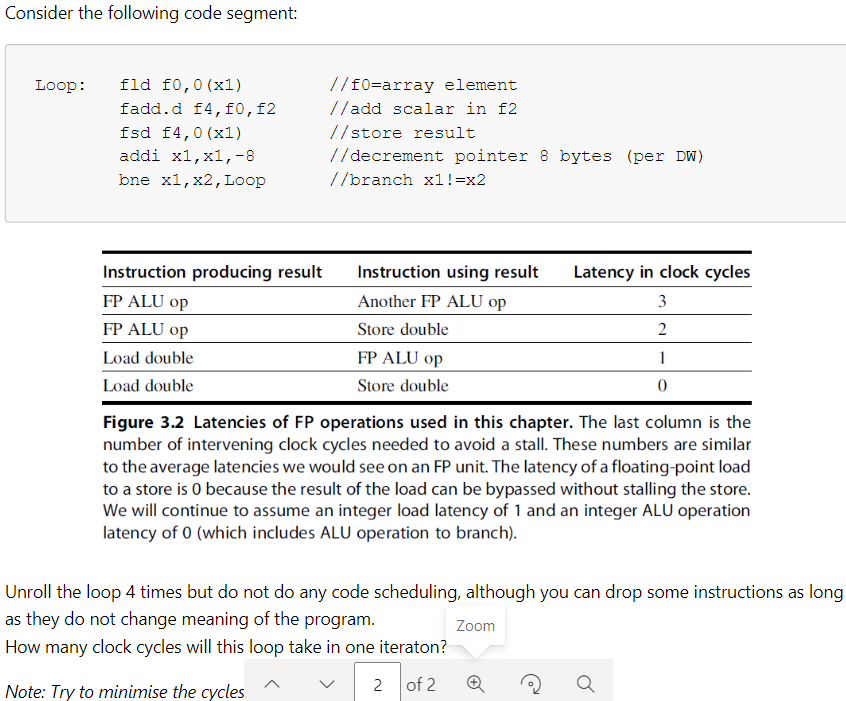
Question: Consider the following code segment: Loop: fld f 0 , 0 ( x 1 ) / / f 0 = array element fadd.d f 4
Consider the following code segment:
Loop: fld fxfarray element
fadd.d fffadd scalar in f
fsd fxstore result
addi xxdecrement pointer bytes per DW
bne xxLoop branch xx
Unroll the loop times but do not do any code scheduling, although you can drop some instructions as longas they do not change meaning of the program.How many clock cycles will this loop take in one iteraton?Consider the following code segment:
Figure Latencies of FP operations used in this chapter. The last column is the
number of intervening clock cycles needed to avoid a stall. These numbers are similar
to the average latencies we would see on an FP unit. The latency of a floatingpoint load
to a store is because the result of the load can be bypassed without stalling the store.
We will continue to assume an integer load latency of and an integer ALU operation
latency of which includes ALU operation to branch
Unroll the loop times but do not do any code scheduling, although you can drop some instructions as long
as they do not change meaning of the program.
How many clock cycles will this loop take in one iteraton?
Note: Try to minimise the cycles
tableof
Step by Step Solution
There are 3 Steps involved in it
1 Expert Approved Answer
Step: 1 Unlock

Question Has Been Solved by an Expert!
Get step-by-step solutions from verified subject matter experts
Step: 2 Unlock
Step: 3 Unlock
 Study Help