







Question: Consider the following code snippet for a Neural Network model: model = Sequential() model.add(Conv2D(filters=4,kernel_size=(5,5),padding='valid', activation='relu', input_shape =(32,32,1))) model.add(MaxPool2D (pool_size=(3,3),strides=(1,1))) model.add(Conv2D(filters=2,kernel_size=(5,5),padding='valid', activation='relu') model.add(MaxPool2D (pool_size=(3,3),strides= (1,1)) )
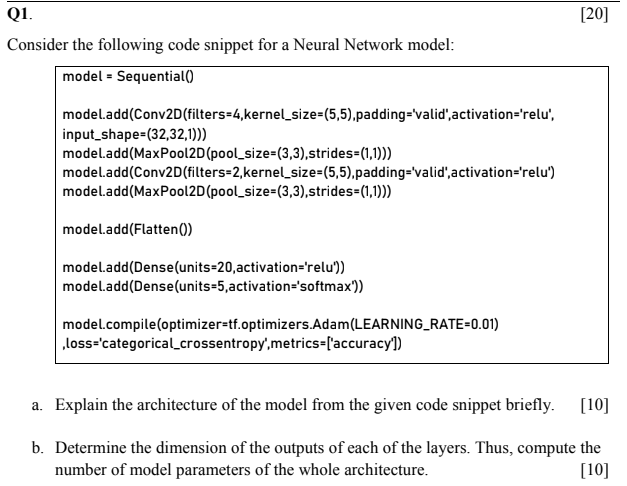
Consider the following code snippet for a Neural Network model: model = Sequential() model.add(Conv2D(filters=4,kernel_size=(5,5),padding='valid', activation='relu', input_shape =(32,32,1))) model.add(MaxPool2D (pool_size=(3,3),strides=(1,1))) model.add(Conv2D(filters=2,kernel_size=(5,5),padding='valid', activation='relu') model.add(MaxPool2D (pool_size=(3,3),strides= (1,1)) ) model.add(Flatten()) model.add(Dense(units=20,activation='relu')) model.add(Dense(units=5, activation='softmax')) model.compile(optimizer=tf.optimizers.Adam(LEARNING_RATE=0.01) ,loss='categorical_crossentropy',metrics=['accuracy']) a. Explain the architecture of the model from the given code snippet briefly. [10] b. Determine the dimension of the outputs of each of the layers. Thus, compute the number of model parameters of the whole architecture. [10]
Step by Step Solution
There are 3 Steps involved in it

Get step-by-step solutions from verified subject matter experts
 Study Help