







Question: Consider the following computation: F = (Axy + Byz - Czx) (A + B C) Suppose we wish to implement this computation using a
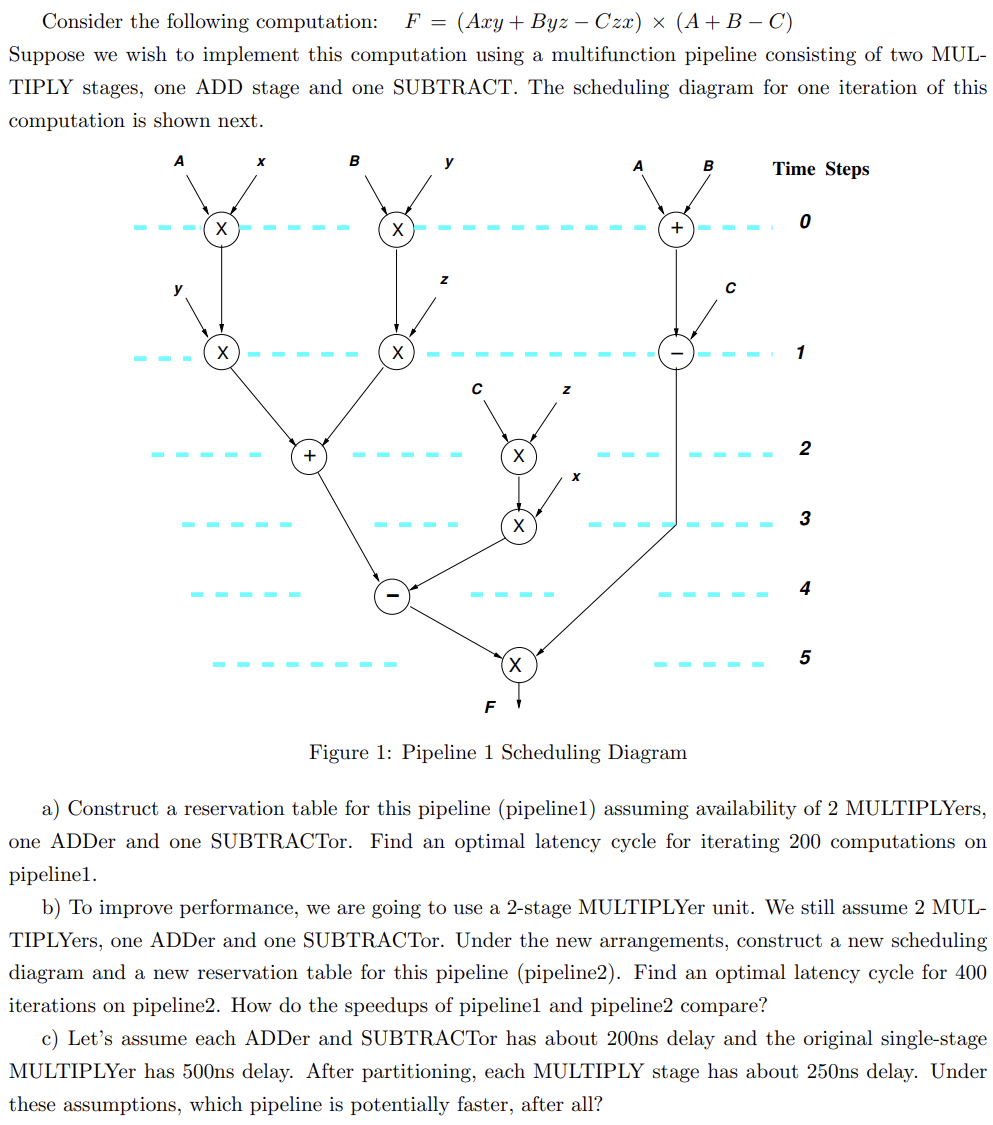
Consider the following computation: F = (Axy + Byz - Czx) (A + B C) Suppose we wish to implement this computation using a multifunction pipeline consisting of two MUL- TIPLY stages, one ADD stage and one SUBTRACT. The scheduling diagram for one iteration of this computation is shown next. A X X X + B X X y C F X X X + Figure 1: Pipeline 1 Scheduling Diagram B Time Steps 0 1 2 3 4 5 a) Construct a reservation table for this pipeline (pipelinel) assuming availability of 2 MULTIPLYers, one ADDer and one SUBTRACTor. Find an optimal latency cycle for iterating 200 computations on pipelinel. b) To improve performance, we are going to use a 2-stage MULTIPLYer unit. We still assume 2 MUL- TIPLYers, one ADDer and one SUBTRACTor. Under the new arrangements, construct a new scheduling diagram and a new reservation table for this pipeline (pipeline2). Find an optimal latency cycle for 400 iterations on pipeline2. How do the speedups of pipelinel and pipeline2 compare? c) Let's assume each ADDer and SUBTRACTor has about 200ns delay and the original single-stage MULTIPLYer has 500ns delay. After partitioning, each MULTIPLY stage has about 250ns delay. Under these assumptions, which pipeline is potentially faster, after all?
Step by Step Solution
3.30 Rating (162 Votes )
There are 3 Steps involved in it
ANSWER General guidance The answer provided below has been developed in a clear stepbystep manner introduction The question concerns the design and optimization of a computational pipeline for a speci... View full answer

Get step-by-step solutions from verified subject matter experts
 Study Help