







Question: Consider the following construction that converts a DFA, M = (Q, sigma, delta, q_0, F), to a context-free grammar, G = (V, sigma, R, S):
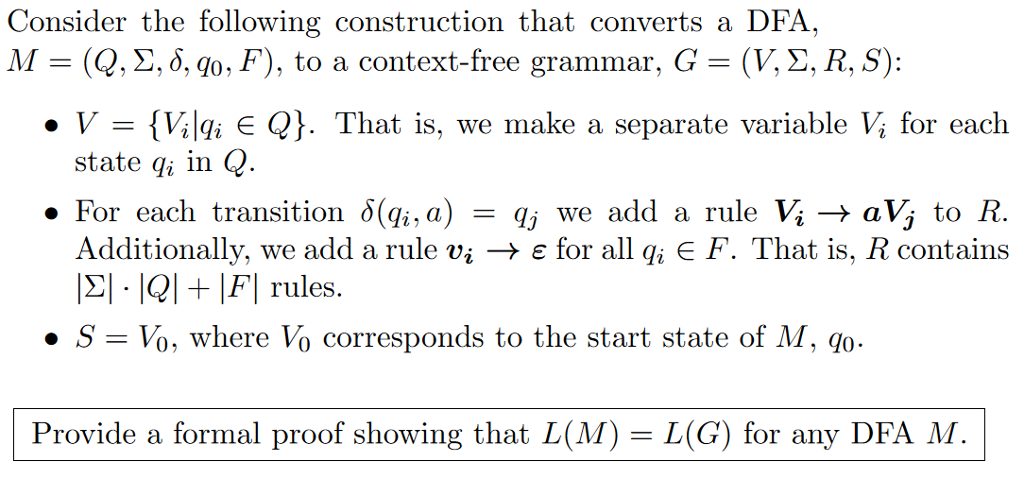
Consider the following construction that converts a DFA, M = (Q, sigma, delta, q_0, F), to a context-free grammar, G = (V, sigma, R, S): V = {V_i\q_i Q}. That is, we make a separate variable V_i for each state qi in Q. For each transition delta(q_i, a) = q_j we add a rule V_i rightarrow a V_j to R. Additionally, we add a rule upsilon_i rightarrow epsilon for all q_i F. That is, R contains |sigma| middot |Q| + |F| rules. S = V_0, where V_0 corresponds to the start state of M, q_0. Provide a formal proof showing that L(M) = L(G) for any DFA M
Step by Step Solution
There are 3 Steps involved in it
1 Expert Approved Answer
Step: 1 Unlock

Question Has Been Solved by an Expert!
Get step-by-step solutions from verified subject matter experts
Step: 2 Unlock
Step: 3 Unlock
 Study Help