







Question: Consider the following data maintained by a bank. Customer ID, Customer Name, Customer Address, Account Number, Account Type, Account Balance, Transaction Number, Transaction Type, Transaction
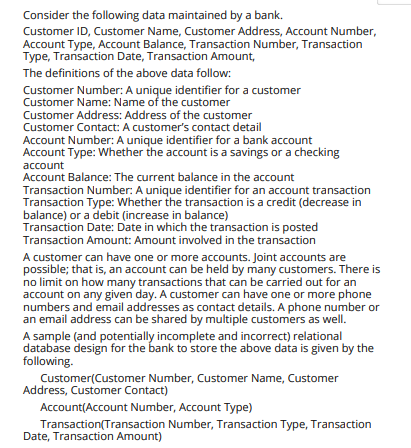
Consider the following data maintained by a bank. Customer ID, Customer Name, Customer Address, Account Number, Account Type, Account Balance, Transaction Number, Transaction Type, Transaction Date, Transaction Amount, The definitions of the above data follow: Customer Number: A unique identifier for a customer Customer Name: Name of the customer Customer Address: Address of the customer Customer Contact: A customer's contact detail Account Number: A unique identifier for a bank account Account Type: Whether the account is a savings or a checking account Account Balance: The current balance in the account Transaction Number: A unique identifier for an account transaction Transaction Type: Whether the transaction is a credit (decrease in balance) or a debit (increase in balance) Transaction Date: Date in which the transaction is posted Transaction Amount: Amount involved in the transaction A customer can have one or more accounts. Joint accounts are possible; that is, an account can be held by many customers. There is no limit on how many transactions that can be carried out for an account on any given day. A customer can have one or more phone numbers and email addresses as contact details. A phone number or an email address can be shared by multiple customers as well. A sample (and potentially incomplete and incorrect) relational database design for the bank to store the above data is given by the following. Customer(Customer Number, Customer Name, Customer Address, Customer Contact) Account(Account Number, Account Type) Transaction(Transaction Number, Transaction Type, Transaction Date, Transaction Amount)
Step by Step Solution
There are 3 Steps involved in it

Get step-by-step solutions from verified subject matter experts
 Study Help