







Question: Consider the following decision problem on graphs, called Bound Problem. We are given an undi- rected graph G with n vertices and a list, called
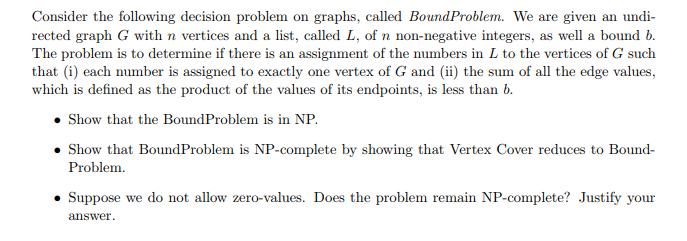
Consider the following decision problem on graphs, called Bound Problem. We are given an undi- rected graph G with n vertices and a list, called L, of n non-negative integers, as well a bound b. The problem is to determine if there is an assignment of the numbers in L to the vertices of G such that (i) each number is assigned to exactly one vertex of G and (ii) the sum of all the edge values, which is defined as the product of the values of its endpoints, is less than b. Show that the Bound Problem is in NP. Show that Bound Problem is NP-complete by showing that Vertex Cover reduces to Bound- Problem. Suppose we do not allow zero-values. Does the problem remain NP-complete? Justify your answer. Consider the following decision problem on graphs, called Bound Problem. We are given an undi- rected graph G with n vertices and a list, called L, of n non-negative integers, as well a bound b. The problem is to determine if there is an assignment of the numbers in L to the vertices of G such that (i) each number is assigned to exactly one vertex of G and (ii) the sum of all the edge values, which is defined as the product of the values of its endpoints, is less than b. Show that the Bound Problem is in NP. Show that Bound Problem is NP-complete by showing that Vertex Cover reduces to Bound- Problem. Suppose we do not allow zero-values. Does the problem remain NP-complete? Justify your
Step by Step Solution
There are 3 Steps involved in it

Get step-by-step solutions from verified subject matter experts
 Study Help