



Question: &. Consider the following declarations of an interface and two dasses that Implement in public interface Measurable double getMeasure) public class Coin implements Measurable public
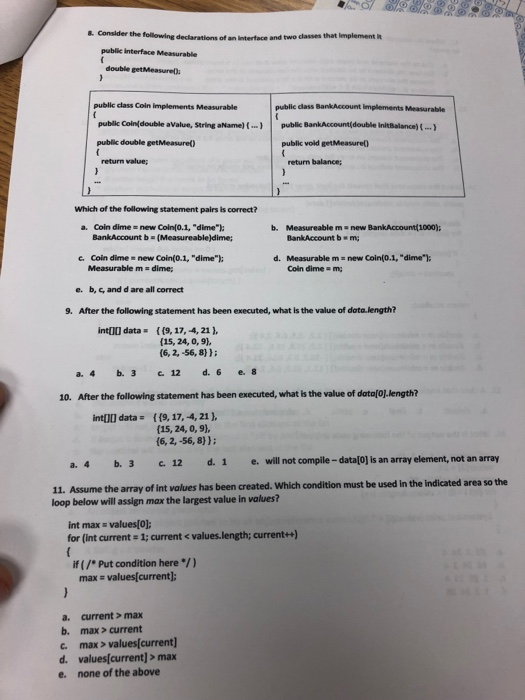
&. Consider the following declarations of an interface and two dasses that Implement in public interface Measurable double getMeasure) public class Coin implements Measurable public dlass BankAccount implements Measurable publilc Coin double aValue, String aName) .public BankAccountdouble InitBalance) (..) public double getMeasure() public vold getMeasure) return value; return balance; Which of the following statement pairs is correct? a. Coin dime- new Coin(0.1, "dime"l b. Measureable m- new BankAccount 1000): BankAccount b mg Measurable m: new Coin(0.1,-dime Coin dime m c. Coin dime = new Coint0.1, "dime"); d. Measurable m dime, e. b, c, and d are all correct After the following statement has been executed, what is the value of dota.length? 9. int0 data((9, 17,4, 21), (15, 24, 0, 9), (6, 2, -56, 8)) 10. After the following statement has been executed, what is the value of data[OL.length? int[II) data-((9, 17,-4, 21) (15, 24, 0, 9), (6, 2,-56,8): a. 4 b. 3 C12 d. 1 e. will not compile-data|o] Is an array element, not an array 11. Assume the array of int values has been created. Which condition must be used in the indicated area so the loop below will assign max the largest value in values int max values[ol for (int current- 1; current max max > current c. d. e. max> values(current) values(current]> max none of the above
Step by Step Solution
There are 3 Steps involved in it

Get step-by-step solutions from verified subject matter experts