







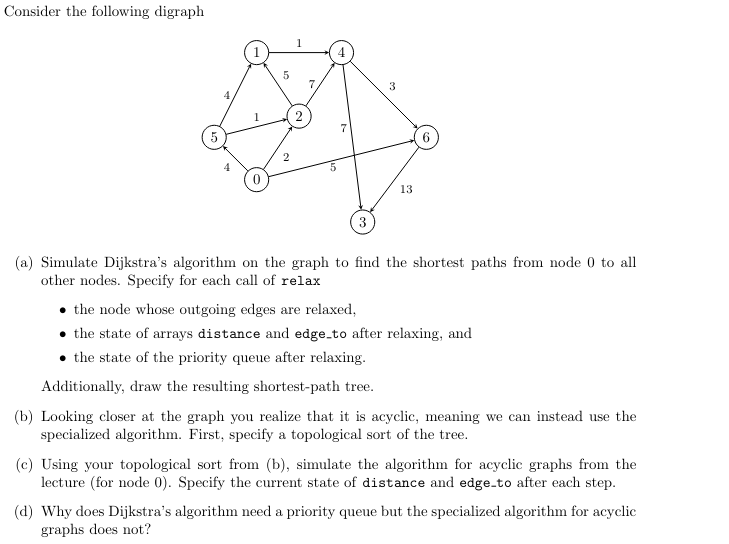
Question: Consider the following digraph ( a ) Simulate Dijkstra's algorithm on the graph to find the shortest paths from node 0 to all other nodes.
Consider the following digraph
a Simulate Dijkstra's algorithm on the graph to find the shortest paths from node to all
other nodes. Specify for each call of relax
the node whose outgoing edges are relaxed,
the state of arrays distance and edgeto after relaxing, and
the state of the priority queue after relaxing.
Additionally, draw the resulting shortestpath tree.
b Looking closer at the graph you realize that it is acyclic, meaning we can instead use the
specialized algorithm. First, specify a topological sort of the tree.
c Using your topological sort from b simulate the algorithm for acyclic graphs from the
lecture for node Specify the current state of distance and edgeto after each step.
d Why does Dijkstra's algorithm need a priority queue but the specialized algorithm for acyclic
graphs does not?
Step by Step Solution
There are 3 Steps involved in it
1 Expert Approved Answer
Step: 1 Unlock

Question Has Been Solved by an Expert!
Get step-by-step solutions from verified subject matter experts
Step: 2 Unlock
Step: 3 Unlock
 Study Help