



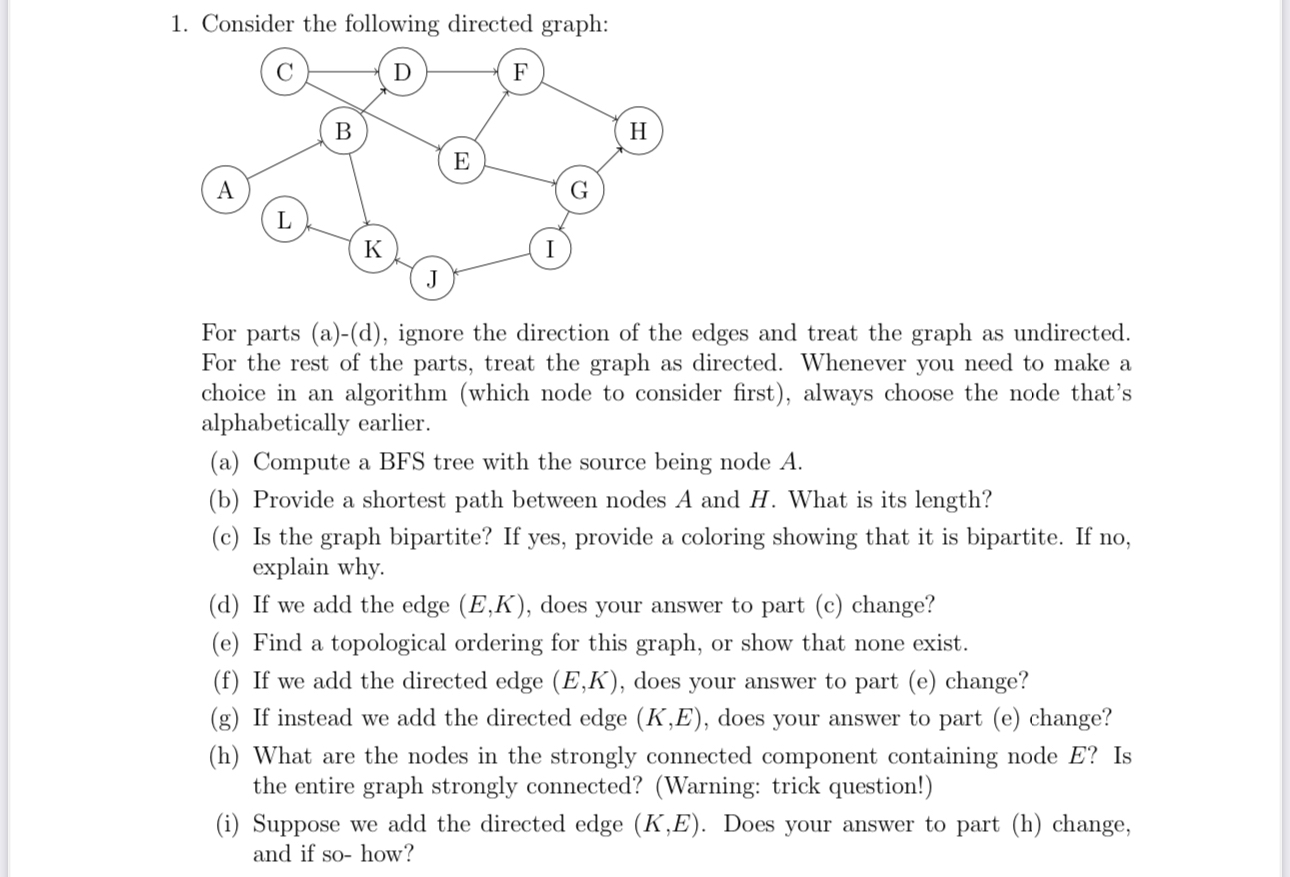
Question: Consider the following directed graph: For parts ( a ) - ( d ) , ignore the direction of the edges and treat the graph
Consider the following directed graph:
For parts ad ignore the direction of the edges and treat the graph as undirected.
For the rest of the parts, treat the graph as directed. Whenever you need to make a
choice in an algorithm which node to consider first always choose the node that's
alphabetically earlier.
a Compute a BFS tree with the source being node
b Provide a shortest path between nodes A and What is its length?
c Is the graph bipartite? If yes, provide a coloring showing that it is bipartite. If no
explain why.
d If we add the edge does your answer to part c change?
e Find a topological ordering for this graph, or show that none exist.
f If we add the directed edge does your answer to part e change?
g If instead we add the directed edge does your answer to part e change?
h What are the nodes in the strongly connected component containing node E Is
the entire graph strongly connected? Warning: trick question!
i Suppose we add the directed edge Does your answer to part h change,
and if so how?
Step by Step Solution
There are 3 Steps involved in it
1 Expert Approved Answer
Step: 1 Unlock

Question Has Been Solved by an Expert!
Get step-by-step solutions from verified subject matter experts
Step: 2 Unlock
Step: 3 Unlock