







Question: Consider the following directed graph G = (V, E) (edges are labeled with edge cost c(e)). a) Use the Moore-Bellman-Ford algorithm to compute the distances
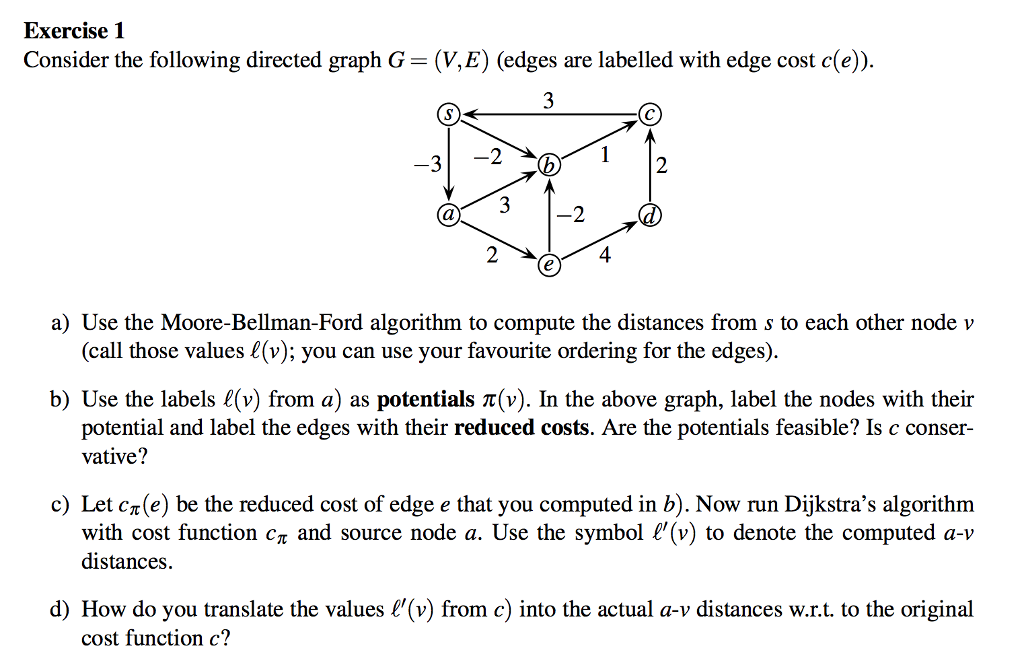
Consider the following directed graph G = (V, E) (edges are labeled with edge cost c(e)). a) Use the Moore-Bellman-Ford algorithm to compute the distances from s to each other node v (call those values l(v); you can use your favourite ordering for the edges). b) Use the labels l(v) from a) as potentials pi(v). In the above graph, label the nodes with their potential and label the edges with their reduced costs. Are the potentials feasible? Is c conservative? c) Let c_pi(e) be the reduced cost of edge e that you computed in b). Now run Dijkstra's algorithm with cost function c_pi and source node a. Use the symbol l'(v) to denote the computed a-v distances. d) How do you translate the values l'(v) from c) into the actual a-v distances w.r.t. to the original cost function c? Consider the following directed graph G = (V, E) (edges are labeled with edge cost c(e)). a) Use the Moore-Bellman-Ford algorithm to compute the distances from s to each other node v (call those values l(v); you can use your favourite ordering for the edges). b) Use the labels l(v) from a) as potentials pi(v). In the above graph, label the nodes with their potential and label the edges with their reduced costs. Are the potentials feasible? Is c conservative? c) Let c_pi(e) be the reduced cost of edge e that you computed in b). Now run Dijkstra's algorithm with cost function c_pi and source node a. Use the symbol l'(v) to denote the computed a-v distances. d) How do you translate the values l'(v) from c) into the actual a-v distances w.r.t. to the original cost function c
Step by Step Solution
There are 3 Steps involved in it

Get step-by-step solutions from verified subject matter experts
 Study Help