







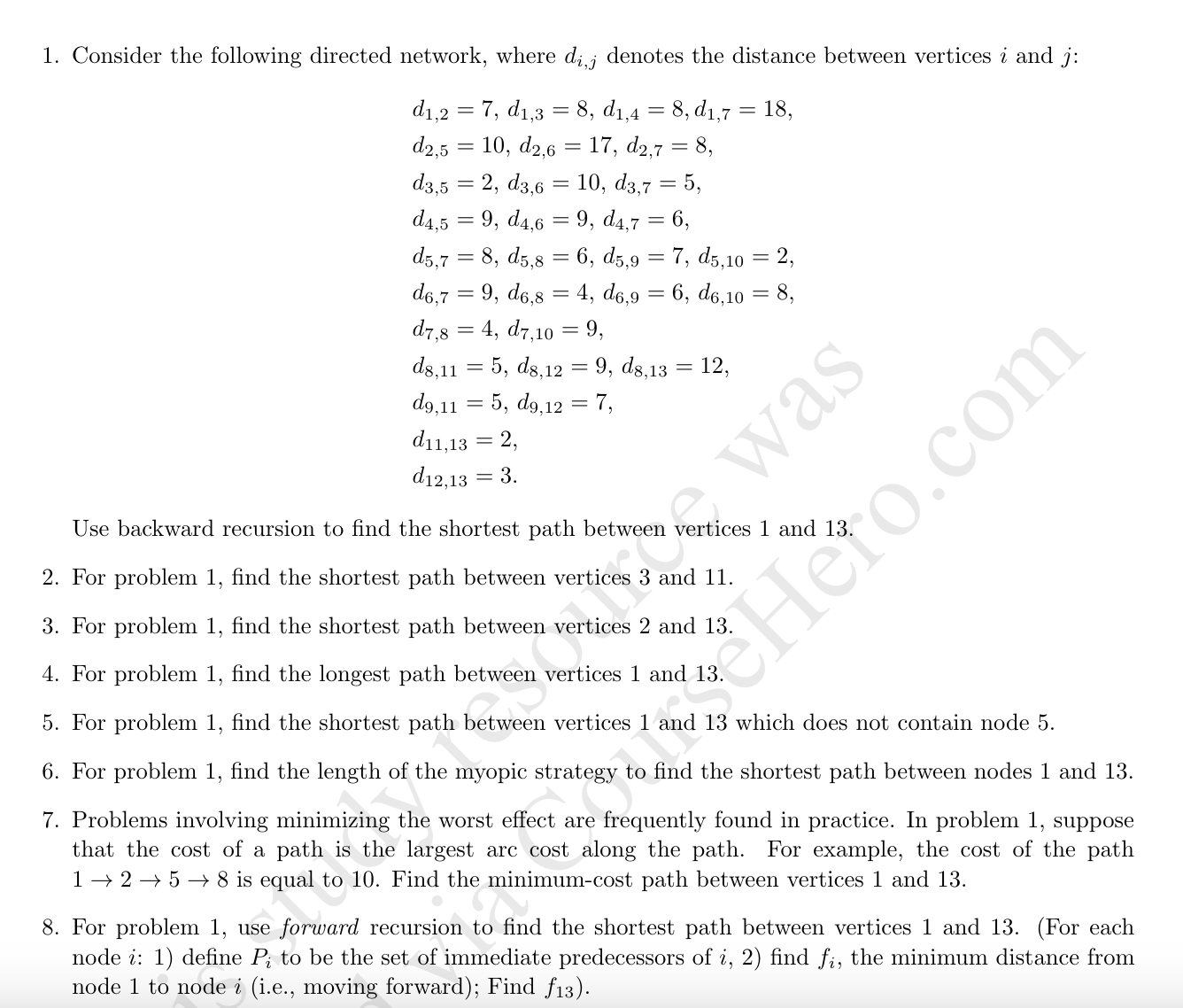
Question: Consider the following directed network, where d i , j denotes the distance between vertices i and j : d 1 , 2 = 7
Consider the following directed network, where denotes the distance between vertices i and :
Use backward recursion to find the shortest path between vertices and
For problem find the shortest path between vertices and
For problem find the shortest path between vertices and
For problem find the longest path between vertices and
For problem find the shortest path between vertices and which does not contain node
For problem find the length of the myopic strategy to find the shortest path between nodes and
Problems involving minimizing the worst effect are frequently found in practice. In problem suppose
that the cost of a path is the largest arc cost along the path. For example, the cost of the path
is equal to Find the minimumcost path between vertices and
For problem use forward recursion to find the shortest path between vertices and For each
node : define to be the set of immediate predecessors of : find the minimum distance from
node to node ie moving forward; Find
Step by Step Solution
There are 3 Steps involved in it
1 Expert Approved Answer
Step: 1 Unlock

Question Has Been Solved by an Expert!
Get step-by-step solutions from verified subject matter experts
Step: 2 Unlock
Step: 3 Unlock
 Study Help