







Question: - Consider the following double spring-mass system: E www Assume that there is no friction or damping. At any time t 0, let y(t)
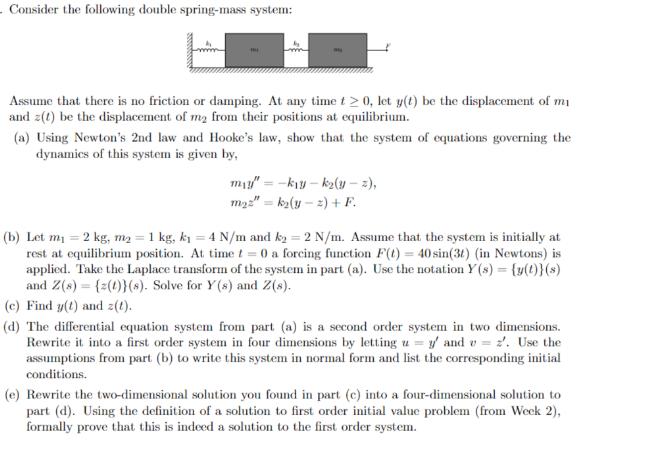
- Consider the following double spring-mass system: E www Assume that there is no friction or damping. At any time t 0, let y(t) be the displacement of mi and z(t) be the displacement of m from their positions at equilibrium. (a) Using Newton's 2nd law and Hooke's law, show that the system of equations governing the dynamics of this system is given by, my"-ky-k(y - z), m"k(y-2) + F. (b) Let m = 2 kg, m = 1 kg, k = 4 N/m and k= 2 N/m. Assume that the system is initially at rest at equilibrium position. At time t = 0 a forcing function F(t) = 40 sin(3) (in Newtons) is applied. Take the Laplace transform of the system in part (a). Use the notation Y(s) = {y(t)}(s) and Z(s) = {z(t)}(s). Solve for Y(s) and Z(s). (e) Find y(t) and z(t). (d) The differential equation system from part (a) is a second order system in two dimensions. Rewrite it into a first order system in four dimensions by letting uy and = 2. Use the assumptions from part (b) to write this system in normal form and list the corresponding initial conditions. (e) Rewrite the two-dimensional solution you found in part (c) into a four-dimensional solution to part (d). Using the definition of a solution to first order initial value problem (from Week 2), formally prove that this is indeed a solution to the first order system.
Step by Step Solution
3.44 Rating (151 Votes )
There are 3 Steps involved in it
a Starting with Newtons second law for each mass and applying Hookes law we get For mass m1 m1y k1y ... View full answer

Get step-by-step solutions from verified subject matter experts
 Study Help