



Question: Consider the following fragment of C code: switch (A) { case 0: C[0] case 1: C[1] } B + 5; break; -A; break; Consider the
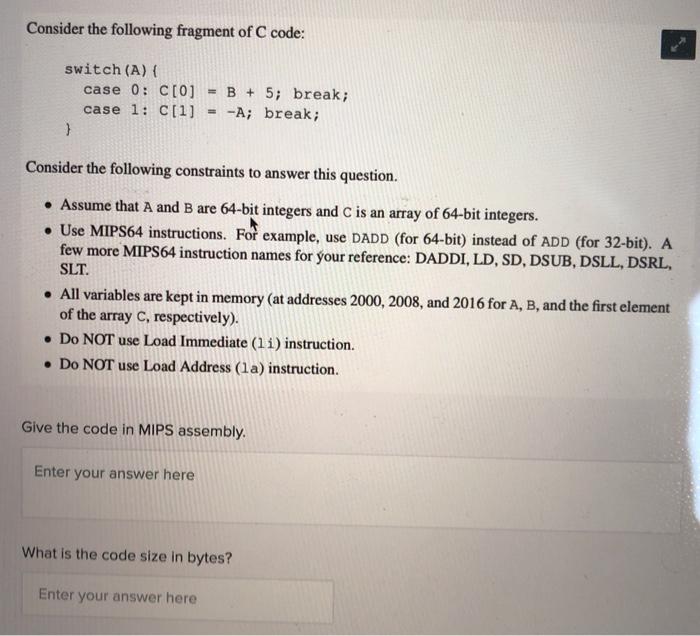
Consider the following fragment of C code: switch (A) { case 0: C[0] case 1: C[1] } B + 5; break; -A; break; Consider the following constraints to answer this question. Assume that A and B are 64-bit integers and C is an array of 64-bit integers. Use MIPS64 instructions. For example, use DADD (for 64-bit) instead of ADD (for 32-bit). A few more MIPS64 instruction names for your reference: DADDI, LD, SD, DSUB, DSLL, DSRL, SLT. . All variables are kept in memory (at addresses 2000, 2008, and 2016 for A, B, and the first element of the array C, respectively). Do NOT use Load Immediate (11) instruction. Do NOT use Load Address (la) instruction. Give the code in MIPS assembly. Enter your answer here What is the code size in bytes? Enter your answer here
Step by Step Solution
There are 3 Steps involved in it

Get step-by-step solutions from verified subject matter experts