



Question: Consider the following functions for non-zero positive integers, p and q. f(p,q) = px px p......... p = p; f (p,1) = p q
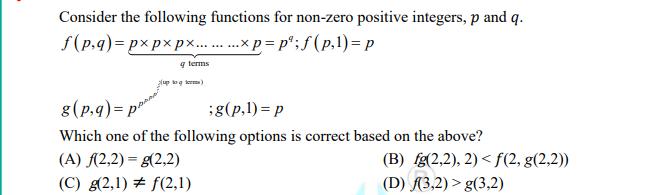
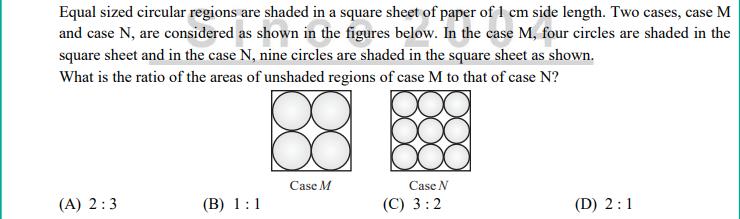
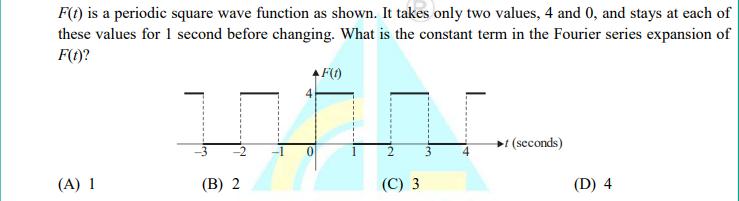
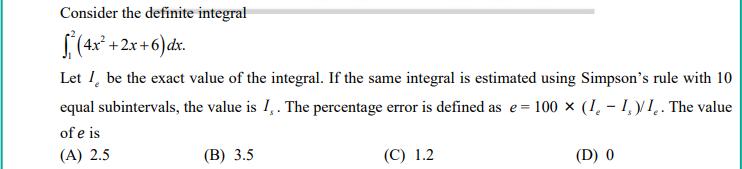

Consider the following functions for non-zero positive integers, p and q. f(p,q) = px px p......... p = p; f (p,1) = p q terms up) g(p,q)= ;g(p,1) = p Which one of the following options is correct based on the above? (A) f(2,2) = g(2,2) (C) g(2,1)f(2,1) (B) fg(2,2), 2) g(3,2) Equal sized circular regions are shaded in a square sheet of paper of 1 cm side length. Two cases, case M and case N, are considered as shown in the figures below. In the case M, four circles are shaded in the square sheet and in the case N, nine circles are shaded in the square sheet as shown. What is the ratio of the areas of unshaded regions of case M to that of case N? Case M Case N (A) 2:3 (B) 1:1 (C) 3:2 (D) 2:1 F(t) is a periodic square wave function as shown. It takes only two values, 4 and 0, and stays at each of these values for 1 second before changing. What is the constant term in the Fourier series expansion of F(t)? F(1) t (seconds) (A) 1 (B) 2 (C) 3 (D) 4 Consider the definite integral (4x+2x+6)dx. Let be the exact value of the integral. If the same integral is estimated using Simpson's rule with 10 equal subintervals, the value is I,. The percentage error is defined as e = 100 x (I - I,) I. The value of e is (A) 2.5 (B) 3.5 (C) 1.2 (D) 0 Given edx= If a and b are positive integers, the value of ea (A) na (B) a e-(x+b) dx is (C) bna (D) b a
Step by Step Solution
There are 3 Steps involved in it

Get step-by-step solutions from verified subject matter experts