







Question: Consider the following hash table array that uses open addressing for collision resolution (only keys are shown in each array entry). 81 42 109 500
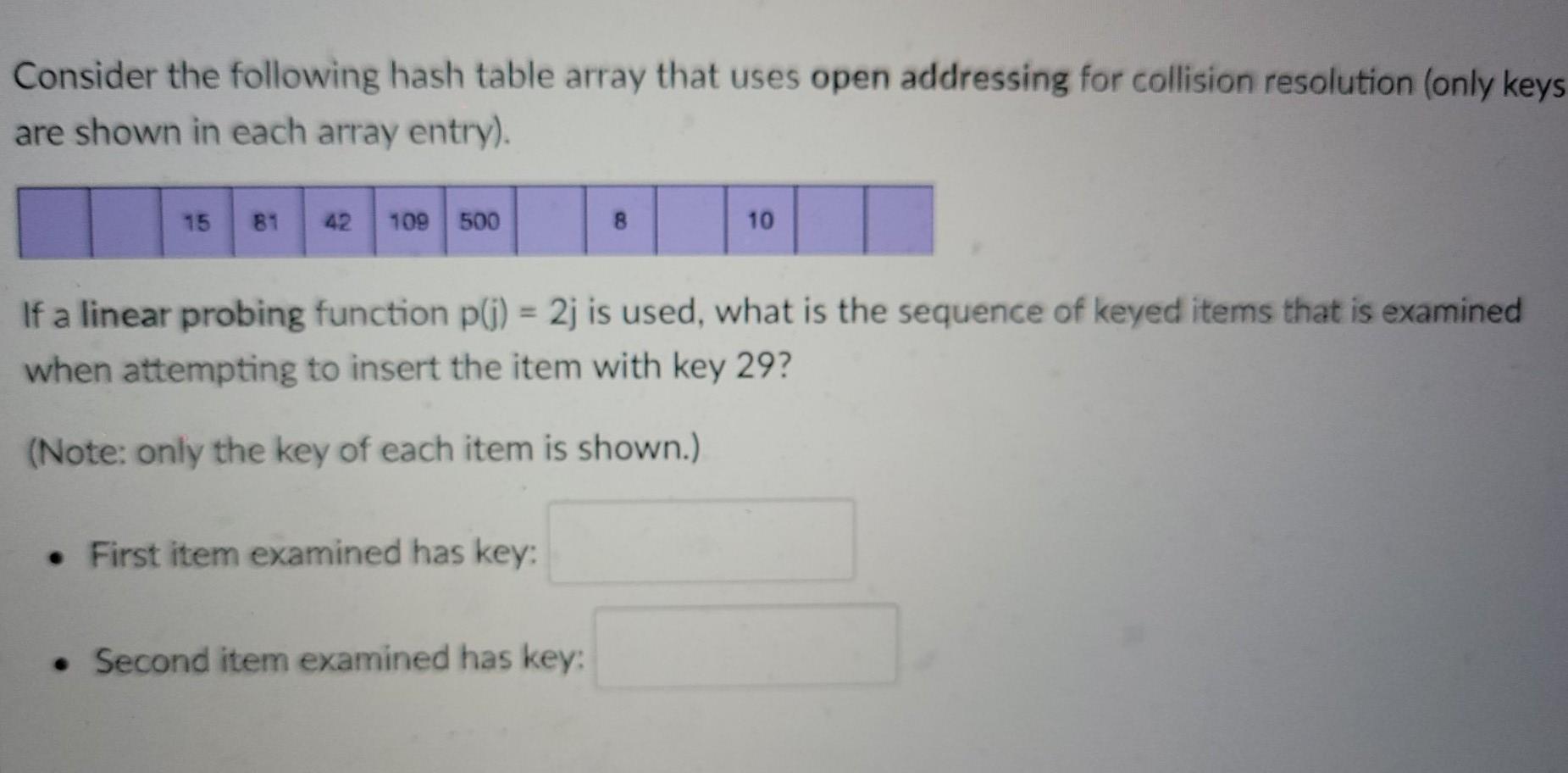
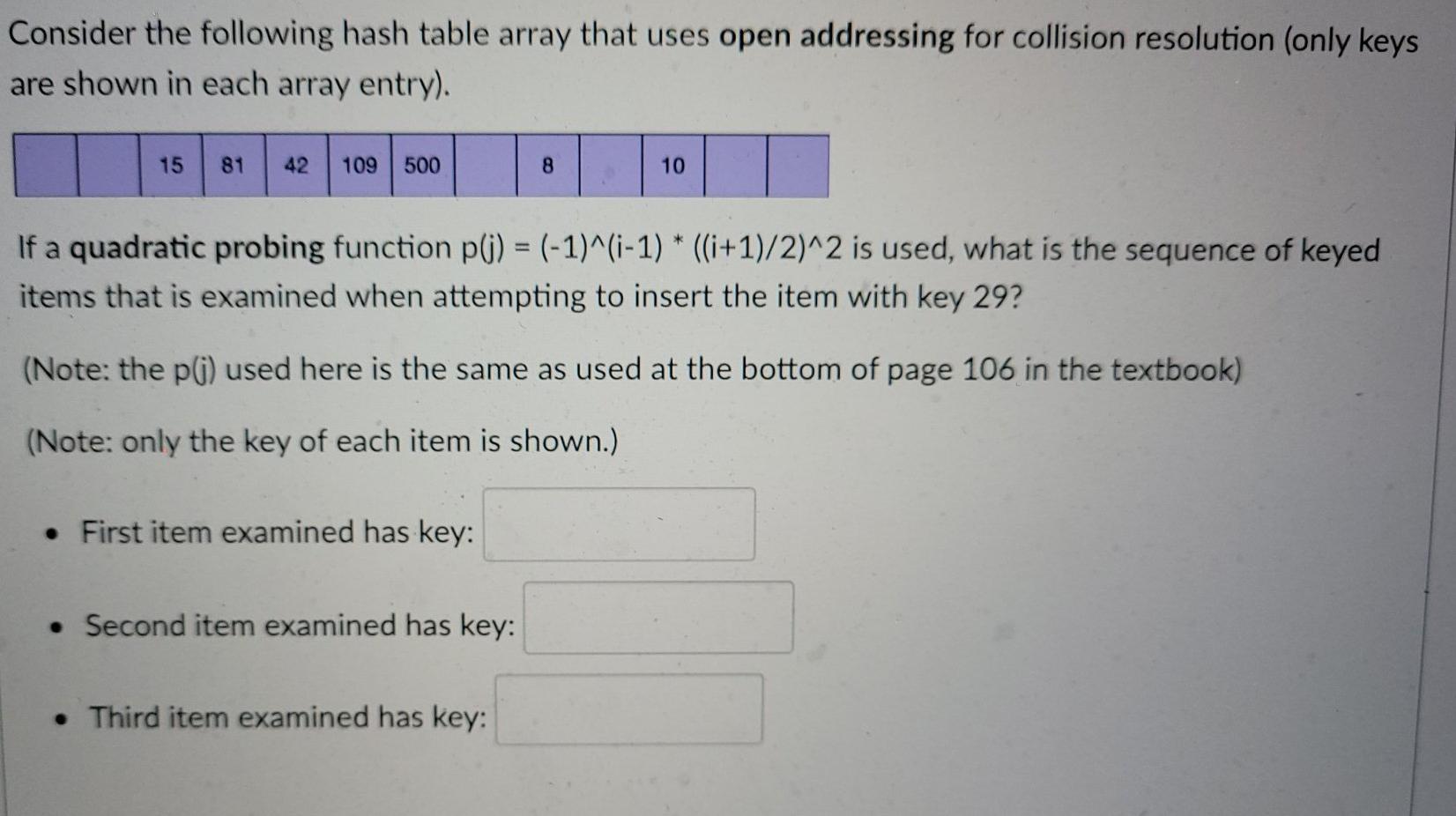
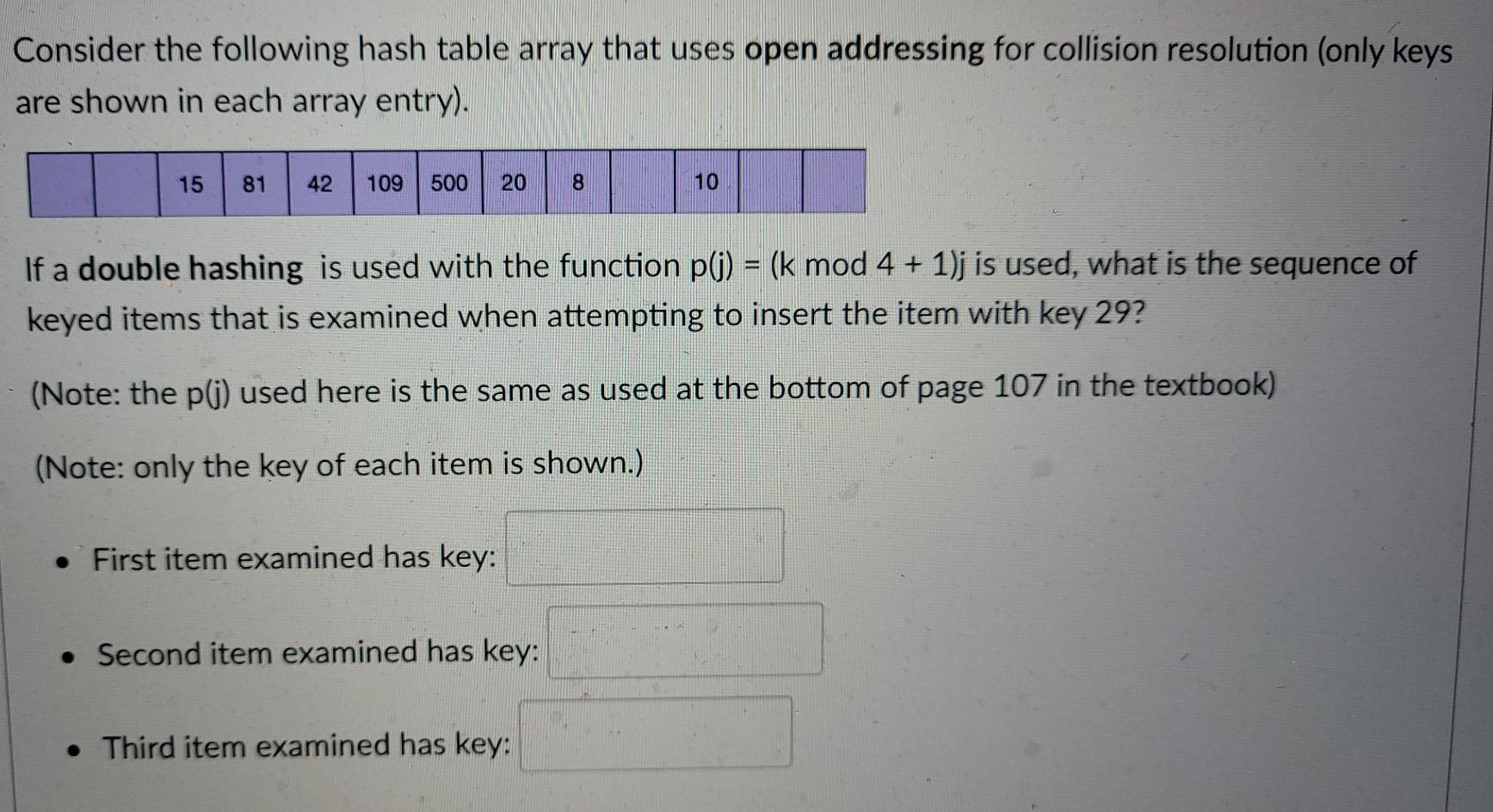
Consider the following hash table array that uses open addressing for collision resolution (only keys are shown in each array entry). 81 42 109 500 8 10 If a linear probing function p(i) = 2j is used, what is the sequence of keyed items that is examined when attempting to insert the item with key 29? (Note: only the key of each item is shown.) First item examined has key: . Second item examined has key: Consider the following hash table array that uses open addressing for collision resolution (only keys are shown in each array entry). 15 81 42 109 500 8 10 If a quadratic probing function p(j) = (-1)^(-1) * ((i+1)/2)^2 is used, what is the sequence of keyed items that is examined when attempting to insert the item with key 29? (Note: the p(j) used here is the same as used at the bottom of page 106 in the textbook) (Note: only the key of each item is shown.) First item examined has key: Second item examined has key: Third item examined has key: Consider the following hash table array that uses open addressing for collision resolution (only keys are shown in each array entry). 15 81 42 109 500 20 8 10 If a double hashing is used with the function p(j) = (k mod 4 + 1)j is used, what is the sequence of keyed items that is examined when attempting to insert the item with key 29? (Note: the p(j) used here is the same as used at the bottom of page 107 in the textbook) (Note: only the key of each item is shown.) First item examined has key: Second item examined has key: Third item examined has key
Step by Step Solution
There are 3 Steps involved in it

Get step-by-step solutions from verified subject matter experts
 Study Help