



Question: Consider the following hypothetical example: it is known that the survival rate for a specific disease is p=85 (or 85% ). Suppose that a researcher
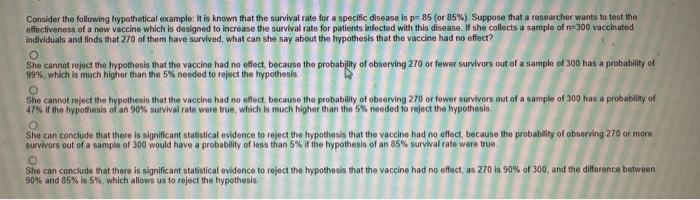
Consider the following hypothetical example: it is known that the survival rate for a specific disease is p=85 (or 85% ). Suppose that a researcher wants to test the effectivenoss of a new vaccine which is designed to increase the survival rate for patients infected with this disease. If she collects ia sample of n=300 vaccinated indliduals and finds that 270 of them have survived, what can she say about the hypothesis that the vaccine had no effect? She cannot reject the hypothenis that the vaccine had no etfect, because the probability of observing 270 or fewer survivors out of a sample of 300 has a probability of 99%, which is much higher than the 5% needed to rejoct the hypothesis She cannot reject the hypothesis that the vaccine had no ellect because the probablity of observing 270 or fewer survivers out of a sample of 300 has a probability of 47% if the typotheals of an 90% survival rate were true, which is much higher than the 5% needed to reject the hypothesis. She can conclude that there is significant statistical evidence to reject the hypothesk that the vaccine had no effect, because the probability of observing 270 ot moce survivors out of a sample of 300 would have a probability of less than 5% if the hypothesis of an 85% survival rate were true. She can conclude that there is significant statistical evidence to reject the hypothesis that the vaccine had no effect, as 270 is 90% of 300 , and the difforence between 90% and 85% is 5%, which allows us to reject the hypothesis
Step by Step Solution
There are 3 Steps involved in it

Get step-by-step solutions from verified subject matter experts