







Question: Consider the following initial value problems y t y(0) = 0 t y(1) = 1 What does the existence and uniqueness theorem tell us
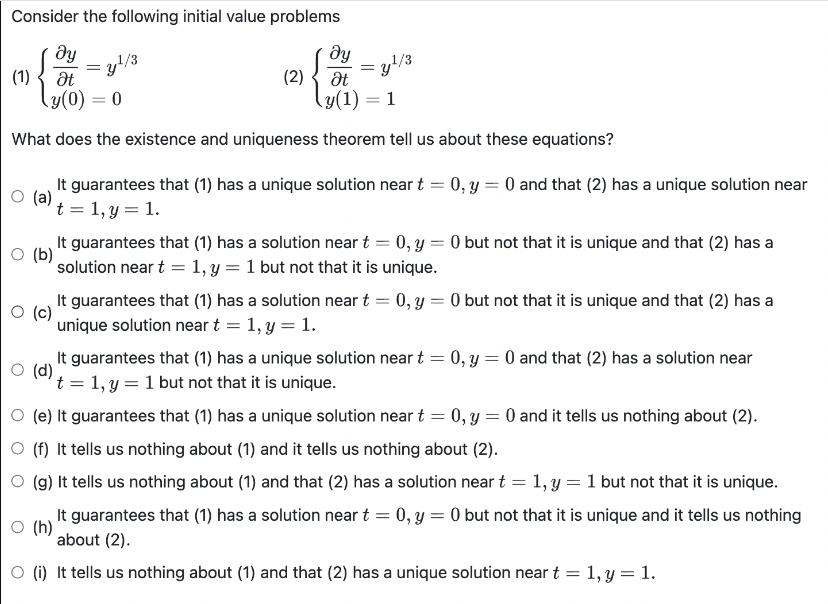
Consider the following initial value problems y t y(0) = 0 t y(1) = 1 What does the existence and uniqueness theorem tell us about these equations? (1) = y/3 (2) = (a) It guarantees that (1) has a unique solution near t = 0, y = 0 and that (2) has a unique solution near t = 1, y = 1. (b) It guarantees that (1) has a solution near t = 0, y = 0 but not that it is unique and that (2) has a solution near t = 1, y = 1 but not that it is unique. O (c) It guarantees that (1) has a solution near t = 0, y = 0 but not that it is unique and that (2) has a unique solution near t = 1, y = 1. O (d) It guarantees that (1) has a unique solution near t = 0, y = 0 and that (2) has a solution near t = 1, y= 1 but not that it is unique. O (e) It guarantees that (1) has a unique solution near t = 0, y = 0 and it tells us nothing about (2). (f) It tells us nothing about (1) and it tells us nothing about (2). (g) It tells us nothing about (1) and that (2) has a solution near t = 1, y = 1 but not that it is unique. O (h) It guarantees that (1) has a solution near t = 0, y = 0 but not that it is unique and it tells us nothing about (2). (i) It tells us nothing about (1) and that (2) has a unique solution near t = 1, y = 1.
Step by Step Solution
There are 3 Steps involved in it
The correct answer is c It guarantees that 1 has a solution near t 0 y 0 but not that it is unique a... View full answer

Get step-by-step solutions from verified subject matter experts
 Study Help