







Question: Consider the following instance: A 2 8 4 5 6 B 2 0 m 8 3 2 4 5 4 4 5 6 D
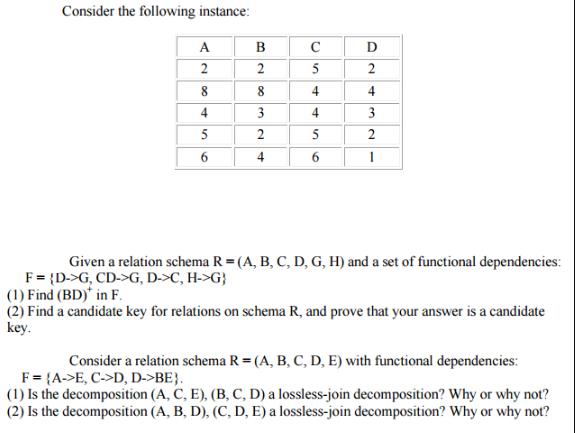
Consider the following instance: A 2 8 4 5 6 B 2 0 m 8 3 2 4 5 4 4 5 6 D 2 4 3 2 1 Given a relation schema R=(A, B, C, D, G, H) and a set of functional dependencies: F = {D->G, CD->G, D->C, H->G} (1) Find (BD)* in F. (2) Find a candidate key for relations on schema R, and prove that your answer is a candidate key. Consider a relation schema R = (A, B, C, D, E) with functional dependencies: F = {A->E, C->D, D->BE}. (1) Is the decomposition (A, C, E), (B, C, D) a lossless-join decomposition? Why or why not? (2) Is the decomposition (A, B, D), (C, D, E) a lossless-join decomposition? Why or why not?
Step by Step Solution
There are 3 Steps involved in it
1 To find BD in F you need to see if theres a functional dependency that involves both B and D Looki... View full answer

Get step-by-step solutions from verified subject matter experts
 Study Help