







Question: Consider the following interpretation in predicate logic: Domain ={ fluffy, thumper, joe, rover, bill, duke, louie, shy, happy } Predicates: R= rabbit, and is true
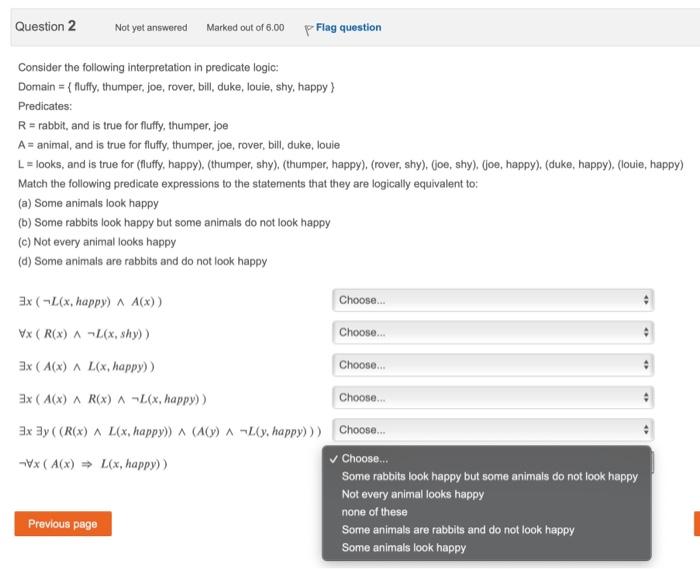
Consider the following interpretation in predicate logic: Domain ={ fluffy, thumper, joe, rover, bill, duke, louie, shy, happy } Predicates: R= rabbit, and is true for fluffy, thumper, joe A= animal, and is true for fluffy, thumper, joe, rover, bill, duke, louie L= looks, and is true for (fluffy, happy), (thumper, shy), (thumper, happy), (rover, shy), (joe, shy), (joe, happy), (duke, happy), (louie, happy) Match the following predicate expressions to the statements that they are logically equivalent to: (a) Some animals look happy (b) Some rabbits look happy but some animals do not look happy (c) Not every animal looks happy (d) Some animals are rabbits and do not look happy x(L(x,happy)A(x)) x(R(x)L(x,shy)) x(A(x)L(x,happy)) x(A(x)R(x)L(x, happy )) xy((R(x)L(x, happy ))(A(y)L(y, happy ))) x(A(x)L(x, happy ))
Step by Step Solution
There are 3 Steps involved in it

Get step-by-step solutions from verified subject matter experts
 Study Help