





Question: Consider the following inventory problem. A camera store stocks a particular model camera that can be ordered weekly. Let D1, D2... represent the demand for
Consider the following inventory problem. A

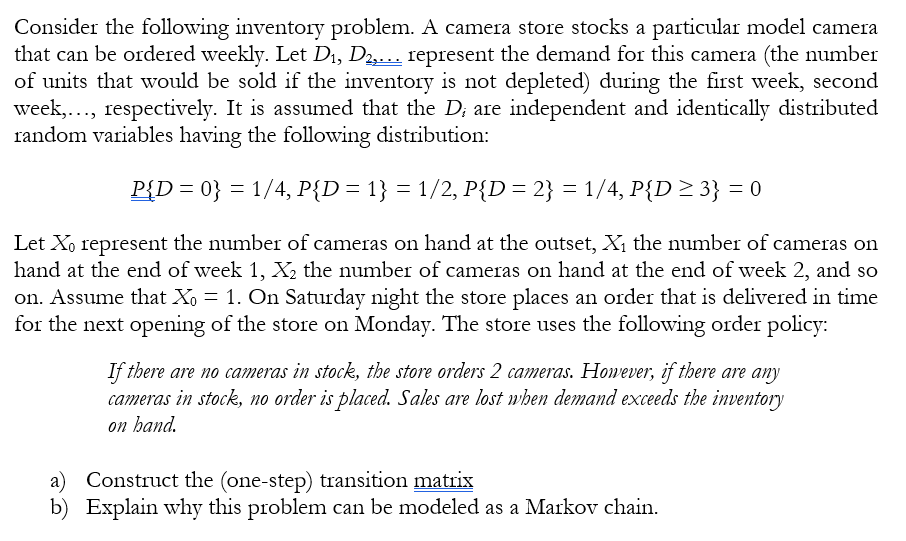
Consider the following inventory problem. A camera store stocks a particular model camera that can be ordered weekly. Let D1, D2... represent the demand for this camera (the number of units that would be sold if the inventory is not depleted) during the first week, second week,..., respectively. It is assumed that the D; are independent and identically distributed random variables having the following distribution: P{D=0} = 1/4, P{D = 1} = 1/2, P{D = 2} = 1/4, P{D > 3} = 0 Let Xo represent the number of cameras on hand at the outset, X the number of cameras on hand at the end of week 1, X2 the number of cameras on hand at the end of week 2, and so on. Assume that Xo = 1. On Saturday night the store places an order that is delivered in time for the next opening of the store on Monday. The store uses the following order policy: If there are no cameras in stock, the store orders 2 cameras. However, if there are any cameras in stock, no order is placed. Sales are lost when demand exceeds the inventory on hand. a) Construct the (one-step) transition matrix b) Explain why this problem can be modeled as a Markov chain

Step by Step Solution

There are 3 Steps involved in it

1 Expert Approved Answer
Step: 1 Unlock blur-text-image

Question Has Been Solved by an Expert!

Get step-by-step solutions from verified subject matter experts

Step: 2 Unlock
Step: 3 Unlock

Students Have Also Explored These Related General Management Questions!