







Question: Consider the following Java class representing a Student with an id and a name with a corresponding equals method implementation, public class Student { private
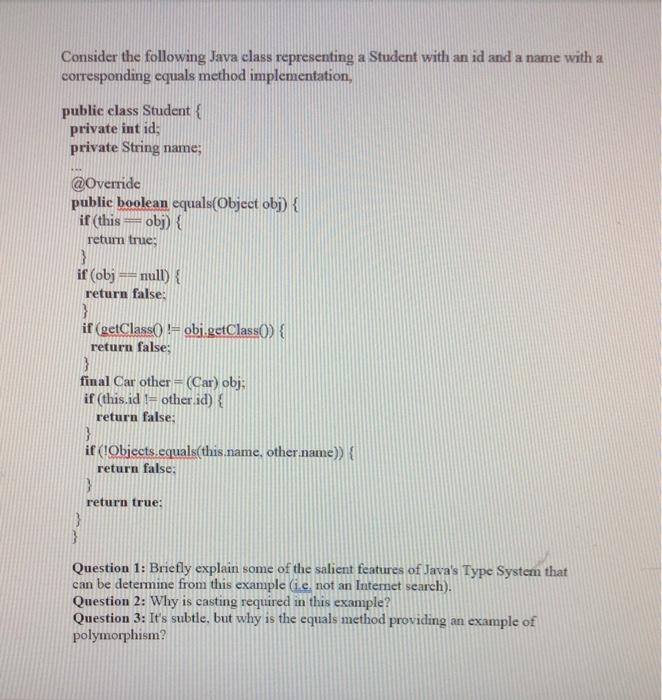
Consider the following Java class representing a Student with an id and a name with a corresponding equals method implementation, public class Student { private int id private String name; @Override public boolean equals(Object obj) { if (this = obj) { return true; } if (obj ==null) { return false; } if (getClass != obj.getClass() { return false; } final Car other (Car) obj: if(this.id != other.id) { return false; } if (!Objects.equals(this name, other name)) { return false; 3 return true: } Question 1: Briefly explain some of the salient features of Java's Type System that can be determine from this example Ge not an Internet search). Question 2: Why is casting required in this example? Question 3: It's subtle, but why is the equals method providing an example of polymorphism
Step by Step Solution
There are 3 Steps involved in it

Get step-by-step solutions from verified subject matter experts
 Study Help