







Question: Consider the following knapsack problem with W = 13: Vi Wi 5 5 4 6 7 8 7 4 (a) Thinking of the above
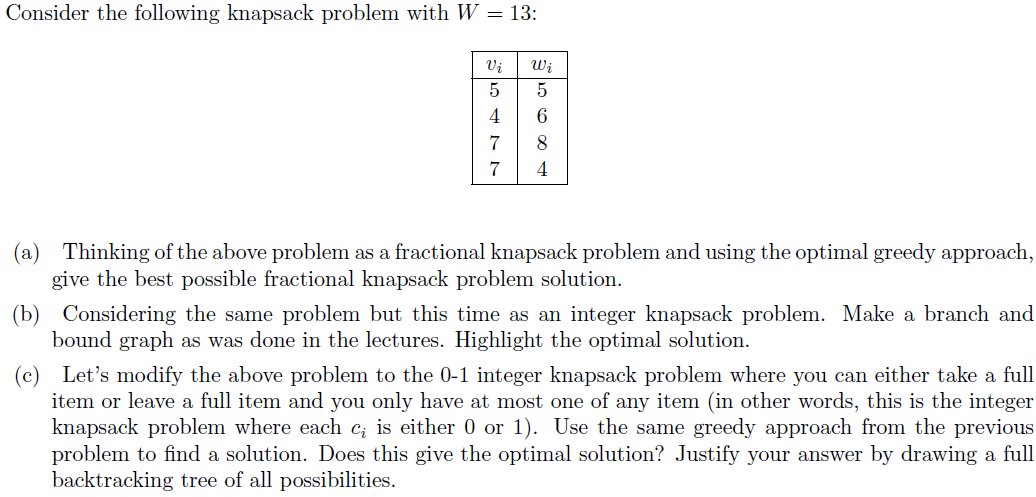
Consider the following knapsack problem with W = 13: Vi Wi 5 5 4 6 7 8 7 4 (a) Thinking of the above problem as a fractional knapsack problem and using the optimal greedy approach, give the best possible fractional knapsack problem solution. (b) Considering the same problem but this time as an integer knapsack problem. Make a branch and bound graph as was done in the lectures. Highlight the optimal solution. (c) Let's modify the above problem to the 0-1 integer knapsack problem where you can either take a full item or leave a full item and you only have at most one of any item (in other words, this is the integer knapsack problem where each c; is either 0 or 1). Use the same greedy approach from the previous problem to find a solution. Does this give the optimal solution? Justify your answer by drawing a full backtracking tree of all possibilities.
Step by Step Solution
3.41 Rating (148 Votes )
There are 3 Steps involved in it
a In the fractional knapsack problem the optimal greedy approach is to sort items by valuetowei... View full answer

Get step-by-step solutions from verified subject matter experts
 Study Help