







Question: Consider the following linear program. Consider the following linear program Max 2A +39 s.t. 54 + 59 $ 410 -1A + 18 $ 10 1A
Consider the following linear program.
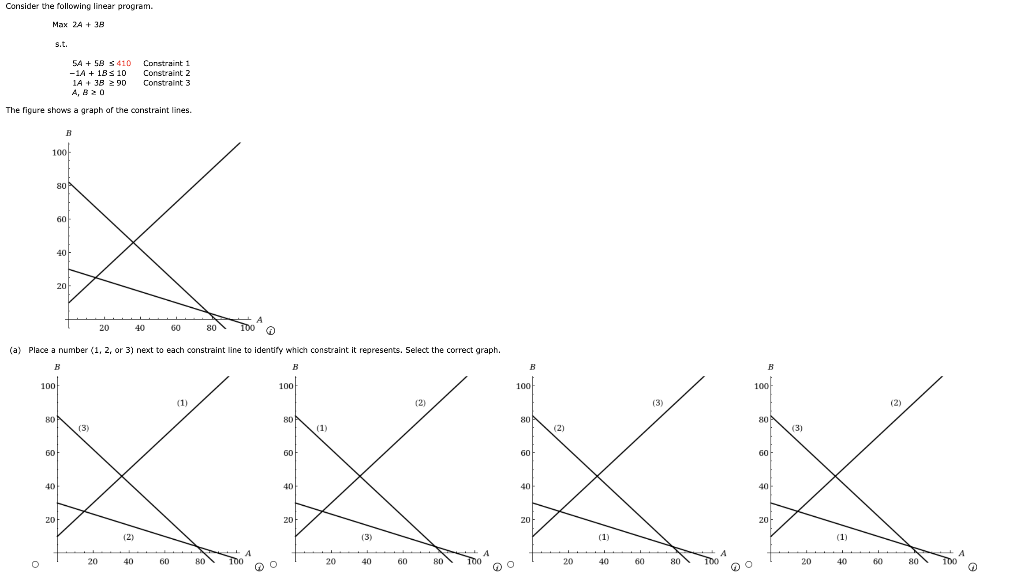
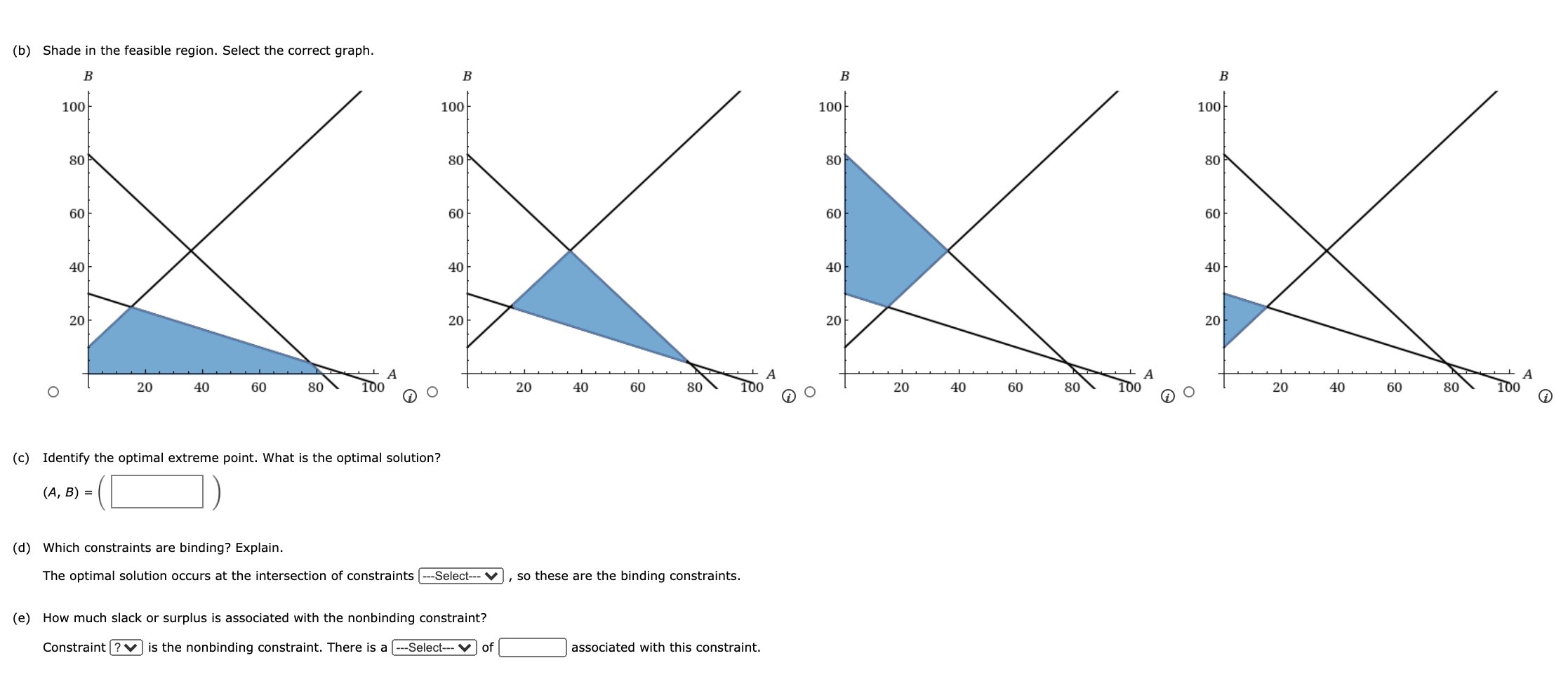
Consider the following linear program Max 2A +39 s.t. 54 + 59 $ 410 -1A + 18 $ 10 1A + 38 90 4,820 Constraint 1 Constraint 2 Constraint 3 The figure shows a graph of the constraint lines. 1001 80 60 40 20 20 40 60 80 100 (a) Place a number (1, 2, or 3) next to each constraint line to identify which constraint it represents. Select the correct graph. B B B B 1001 100 100 1001 (1) (2) (3) (2) 80 80 80 80 (1) (2) (3) 60 60 60 60 40 40 40 40 20 20 201 20 (2) (3) (1) (1) A 100 20 40 A 10XE 40 A 100 60 80 A 100 o 20 80 60 40 20 60 80 40 20 80 60 (b) Shade in the feasible region. Select the correct graph. B B B B 100 1001 100 100 80 80 80 80 60 60 60 60 40 40 40 40 20 20 20 20 20 40 60 80 20 40 60 80 100 20 40 60 80 100 20 40 60 80 100 (c) Identify the optimal extreme point. What is the optimal solution? (A, B) = (d) Which constraints are binding? Explain. The optimal solution occurs at the intersection of constraints -Select--- , so these are the binding constraints. (e) How much slack or surplus is associated with the nonbinding constraint? Constraint ?V is the nonbinding constraint. There is a ---Select--- Vof associated with this constraint
Step by Step Solution
There are 3 Steps involved in it

Get step-by-step solutions from verified subject matter experts
 Study Help