







Question: Consider the following linear program: maximize subject to 3x1 + 4x2 + 3x3 + 6x4 2x1 + x2-x3 + x4 x1 + x2 +
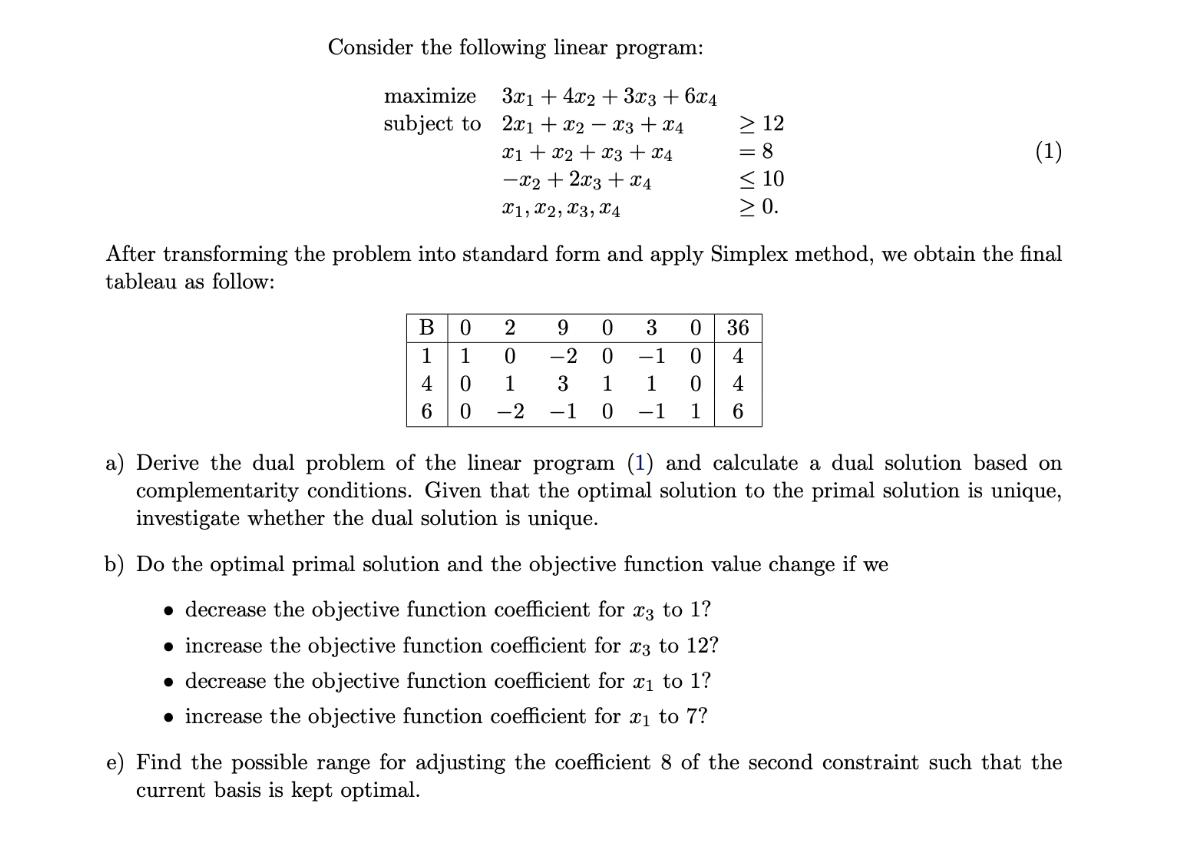
Consider the following linear program: maximize subject to 3x1 + 4x2 + 3x3 + 6x4 2x1 + x2-x3 + x4 x1 + x2 + x3 + x4 -x2 + 2x3 + x4 X1, X2, x3, x4 > 12 = 8 10 0. (1) After transforming the problem into standard form and apply Simplex method, we obtain the final tableau as follow: B 0 2 9 0 3 0 36 1 1 0 -2 0 -1 0 4 4 0 1 3 1 1 0 4 6 0 -2 -1 0 -1 1 6 a) Derive the dual problem of the linear program (1) and calculate a dual solution based on complementarity conditions. Given that the optimal solution to the primal solution is unique, investigate whether the dual solution is unique. b) Do the optimal primal solution and the objective function value change if we decrease the objective function coefficient for x3 to 1? increase the objective function coefficient for x3 to 12? . decrease the objective function coefficient for x to 1? increase the objective function coefficient for x to 7? e) Find the possible range for adjusting the coefficient 8 of the second constraint such that the current basis is kept optimal.
Step by Step Solution
3.52 Rating (159 Votes )
There are 3 Steps involved in it
Problem a 1 Derive the dual problem of the linear program 1 The dual problem of a linear program is a problem that is formulated by interchanging the ... View full answer

Get step-by-step solutions from verified subject matter experts
 Study Help