







Question: Consider the following linear programming problem: 4x + 2x + 5x3 X1 x + x3 430 3x + 2x3 460 X + 4x 420
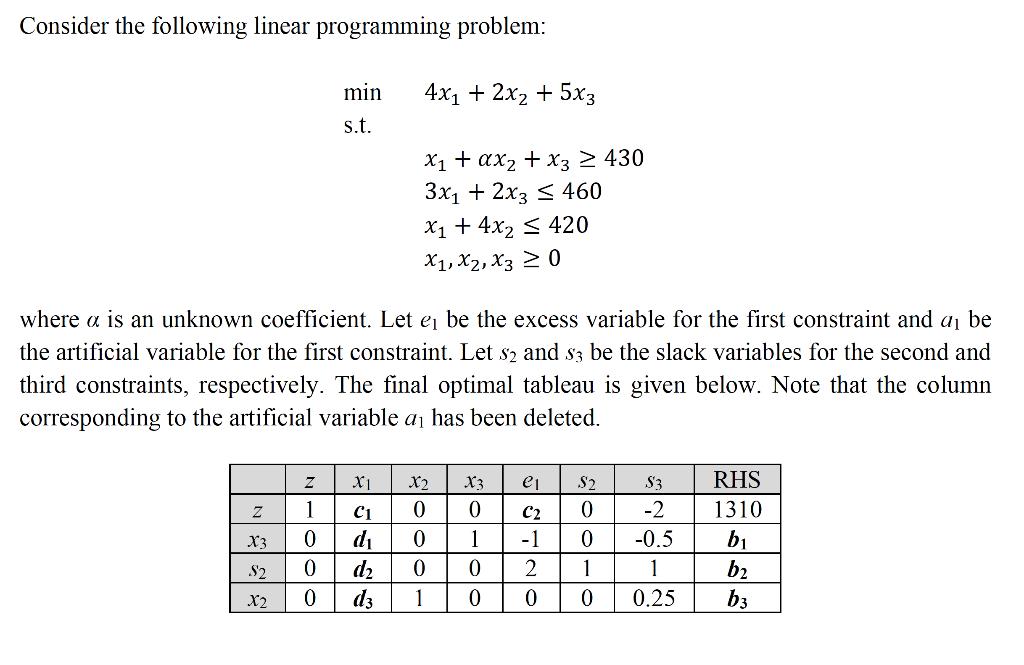
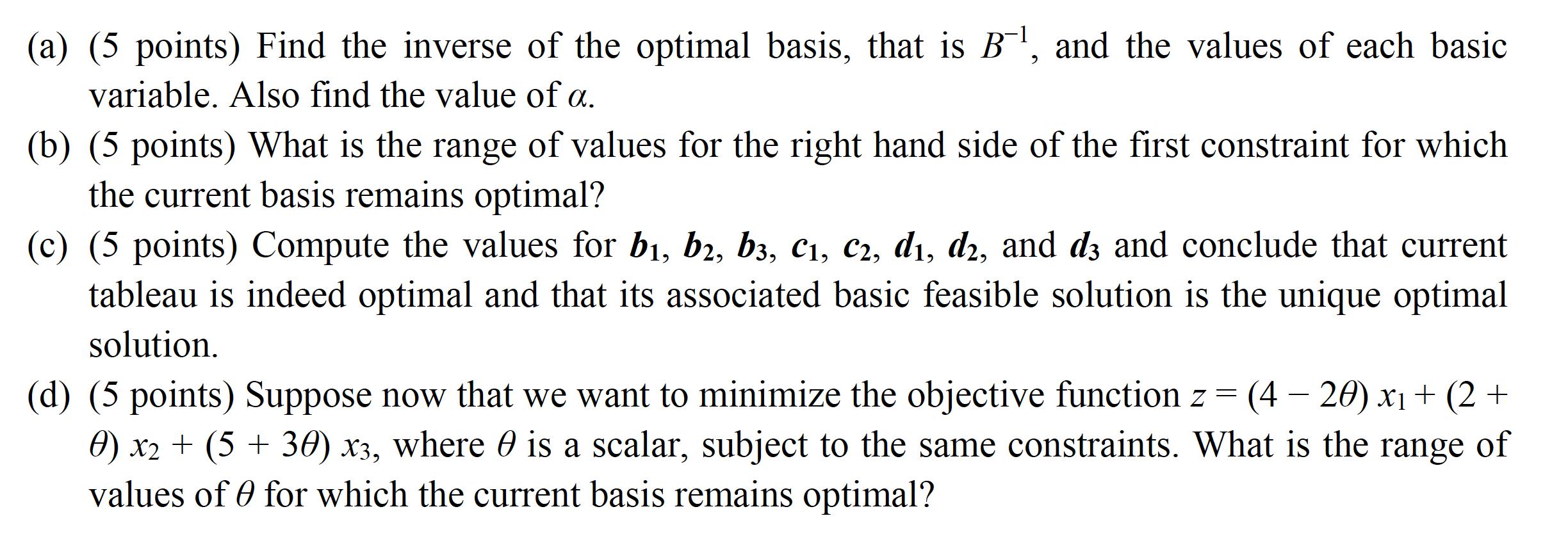
Consider the following linear programming problem: 4x + 2x + 5x3 X1 x + x3 430 3x + 2x3 460 X + 4x 420 X1, X2, X3 20 where a is an unknown coefficient. Let ej be the excess variable for the first constraint and a be the artificial variable for the first constraint. Let 82 and 83 be the slack variables for the second and third constraints, respectively. The final optimal tableau is given below. Note that the column corresponding to the artificial variable a has been deleted. Z X3 $2 elic 33 X2 min s.t. Z 1 0 0 0 X1 X2 X3 0 0 0 1 C1 d d SR d3 e 0 C2 1 -1 0 2 0 0 $2 0 0 1 To 0 $3 -2 -0.5 1 0.25 RHS 1310 b b b3 (a) (5 points) Find the inverse of the optimal basis, that is B, and the values of each basic variable. Also find the value of a. (b) (5 points) What is the range of values for the right hand side of the first constraint for which the current basis remains optimal? (c) (5 points) Compute the values for b, b2, b3, C, C2, d, d2, and d3 and conclude that current tableau is indeed optimal and that its associated basic feasible solution is the unique optimal solution. (d) (5 points) Suppose now that we want to minimize the objective function z = (4 - 20) x + (2 + 0) x + (5 +30) x3, where is a scalar, subject to the same constraints. What is the range of values of 0 for which the current basis remains optimal?
Step by Step Solution
There are 3 Steps involved in it

Get step-by-step solutions from verified subject matter experts
 Study Help