







Question: Consider the following matrix A: A = 5 0 0 0 0 3 0 0 0 3 0 We are interested in the linear
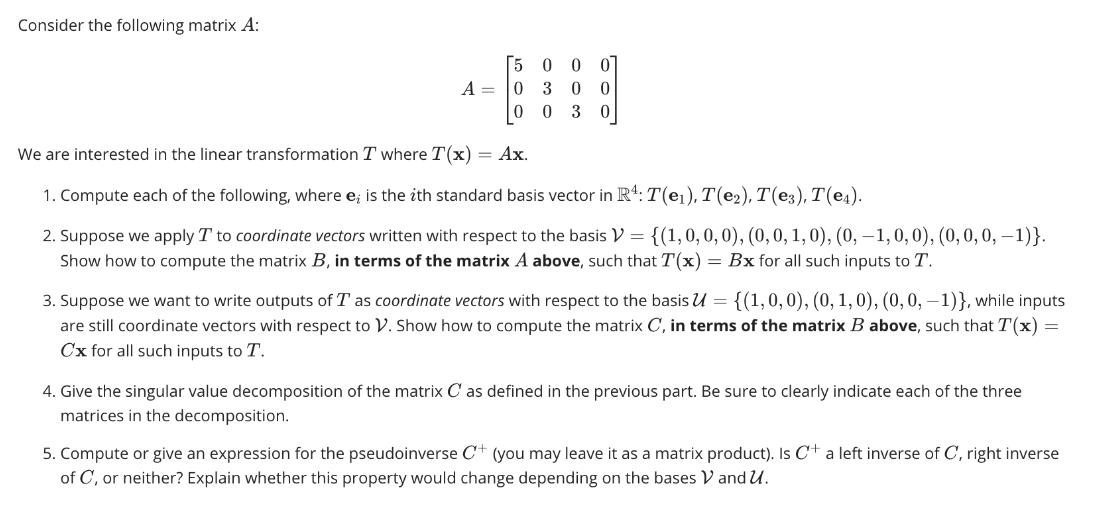
Consider the following matrix A: A = 5 0 0 0 0 3 0 0 0 3 0 We are interested in the linear transformation T where T(x) = Ax. 1. Compute each of the following, where e; is the ith standard basis vector in R4: T(e), T(e2), T(e3), T(e4). 2. Suppose we apply T to coordinate vectors written with respect to the basis V= {(1, 0, 0, 0), (0, 0, 1, 0), (0, -1, 0, 0), (0, 0, 0, -1)}. Show how to compute the matrix B, in terms of the matrix A above, such that T(x) = Bx for all such inputs to T. 3. Suppose we want to write outputs of T as coordinate vectors with respect to the basis U = {(1, 0, 0), (0, 1, 0), (0, 0, -1)}, while inputs are still coordinate vectors with respect to V. Show how to compute the matrix C, in terms of the matrix B above, such that T(x) Cx for all such inputs to T. 4. Give the singular value decomposition of the matrix C as defined in the previous part. Be sure to clearly indicate each of the three matrices in the decomposition. = 5. Compute or give an expression for the pseudoinverse C+ (you may leave it as a matrix product). Is C+ a left inverse of C, right inverse of C, or neither? Explain whether this property would change depending on the bases V and U.
Step by Step Solution
3.34 Rating (148 Votes )
There are 3 Steps involved in it
To solve the given questions lets go step by step 1 Compute Te Te Te Te For a linear transformation Tx Ax where A is the given matrix Te A e 5000 0 0 ... View full answer

Get step-by-step solutions from verified subject matter experts
 Study Help