







Question: Consider the following method for solving the ODE y = f(y,t) y=yn + hf (yn, ta) Y+1=Yn+haf (y..t+1)+(1-a) f(un.tu)) where 0 a 1 (a)
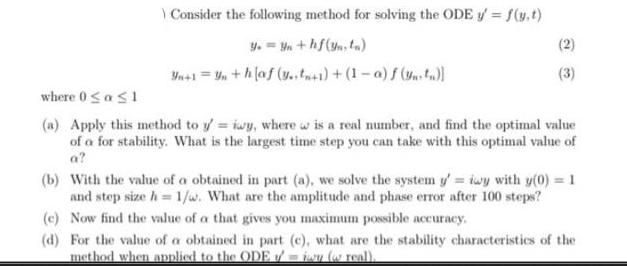
Consider the following method for solving the ODE y = f(y,t) y=yn + hf (yn, ta) Y+1=Yn+haf (y..t+1)+(1-a) f(un.tu)) where 0 a 1 (a) Apply this method to y'=iwy, where is a real number, and find the optimal value of a for stability. What is the largest time step you can take with this optimal value of a? (b) With the value of a obtained in part (a), we solve the system y'= iwy with y(0) = 1 and step size h = 1/w. What are the amplitude and phase error after 100 steps? (e) Now find the value of a that gives you maximum possible accuracy. (d) For the value of a obtained in part (e), what are the stability characteristics of the method when applied to the ODE (w real).
Step by Step Solution
3.35 Rating (155 Votes )
There are 3 Steps involved in it
if power is measured from these two quantiter Uncertenity in the P R AP 2 A1 AR logm blogm 2x05 ... View full answer

Get step-by-step solutions from verified subject matter experts
 Study Help