







Question: Consider the following MIPS program Consider the following MIPS program start: li $t0, 0 li$t1, 0 li $t2, 0x3fffffff brazos: bge $t0,$al, haris mul $t3,
Consider the following MIPS program
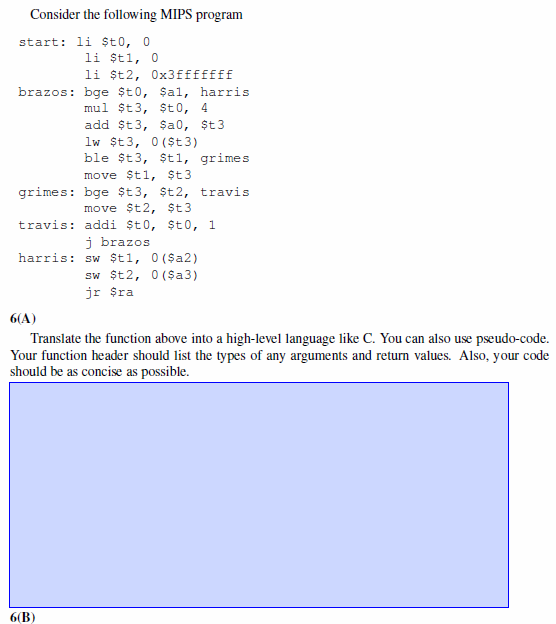
Consider the following MIPS program start: li $t0, 0 li$t1, 0 li $t2, 0x3fffffff brazos: bge $t0,$al, haris mul $t3, $t0, 4 add $t3, $a0, $t3 lw $t3, $a0,$t3 lw$t3, $t1, grimes move $t1, $t3 grimes: bge $t3, $t2, travis move $t2, $t3 travis: addi $t0, $t0, 1 j brazos harris: sw $t2, 0($a2) sw $st2, 0($a3) jr $ra Translate the function above into a high-level language like C. You can also use pseudo-code. Your function header should list the types of any arguments and return values. Also, your code should be as concise as possible. Consider the following MIPS program start: li $t0, 0 li$t1, 0 li $t2, 0x3fffffff brazos: bge $t0,$al, haris mul $t3, $t0, 4 add $t3, $a0, $t3 lw $t3, $a0,$t3 lw$t3, $t1, grimes move $t1, $t3 grimes: bge $t3, $t2, travis move $t2, $t3 travis: addi $t0, $t0, 1 j brazos harris: sw $t2, 0($a2) sw $st2, 0($a3) jr $ra Translate the function above into a high-level language like C. You can also use pseudo-code. Your function header should list the types of any arguments and return values. Also, your code should be as concise as possible
Step by Step Solution
There are 3 Steps involved in it

Get step-by-step solutions from verified subject matter experts
 Study Help