


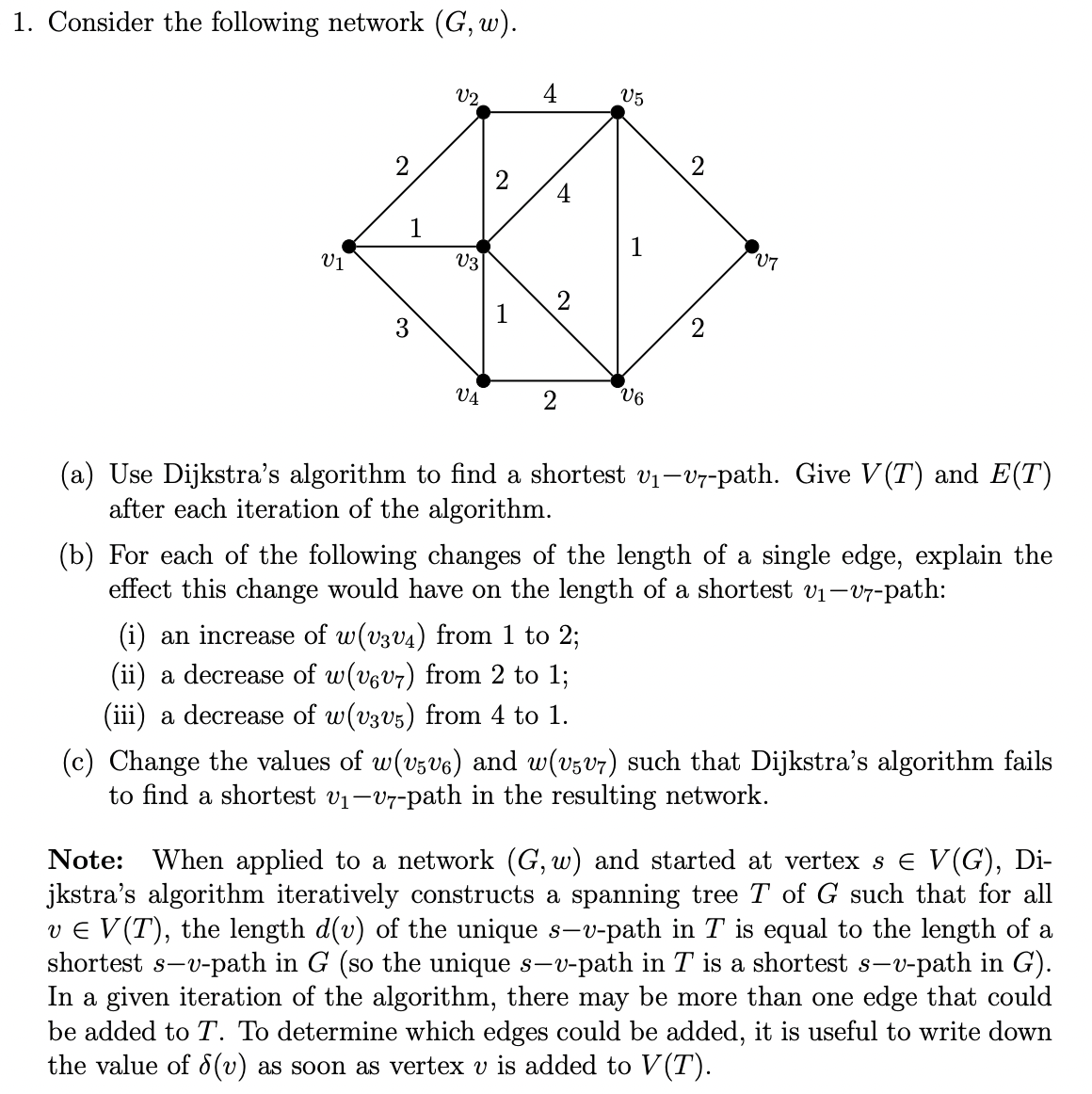
Question: . Consider the following network (G, to). (a) Use Dijkstra's algorithm to nd a shortest v1 'U7-path. Give V(T) and E(T) after each iteration of
. Consider the following network (G, to). (a) Use
. Consider the following network (G, to). (a) Use Dijkstra's algorithm to nd a shortest v1 'U7-path. Give V(T) and E(T) after each iteration of the algorithm. (b) For each of the following changes of the length of a single edge, explain the effect this change would have on the length of a shortest v1 'v7-path: (i) an increase of 1.9023124) from 1 to 2; (ii) a decrease of w(v6v7) from 2 to 1; (iii) a decrease of w(v3v5) from 4 to 1. (c) Change the values of w(v5v5) and w('v5v7) such that Dijkstra's algorithm fails to nd a shortest '01'07-path in the resulting network. Note: When applied to a network (0,10) and started at vertex 3 E V(G), Di- jkstra's algorithm iteratively constructs a spanning tree T of G such that for all '0 E V(T), the length (1(1)) of the unique so-path in T is equal to the length of a shortest sv-path in G (so the unique sv-path in T is a shortest svpath in G). In a given iteration of the algorithm, there may be more than one edge that could be added to T. To determine which edges could be added, it is useful to write down the value of 6(2)) as soon as vertex v is added to V(T)

Step by Step Solution

There are 3 Steps involved in it

1 Expert Approved Answer
Step: 1 Unlock blur-text-image
Question Has Been Solved by an Expert!

Get step-by-step solutions from verified subject matter experts

Step: 2 Unlock
Step: 3 Unlock

Students Have Also Explored These Related Mathematics Questions!