







Question: Consider the following optimisation problem for the decision variables x and y: IggFle-yl = -(2-sl2 [1 slg at. 511: {A} a 5 $2 (a) FED
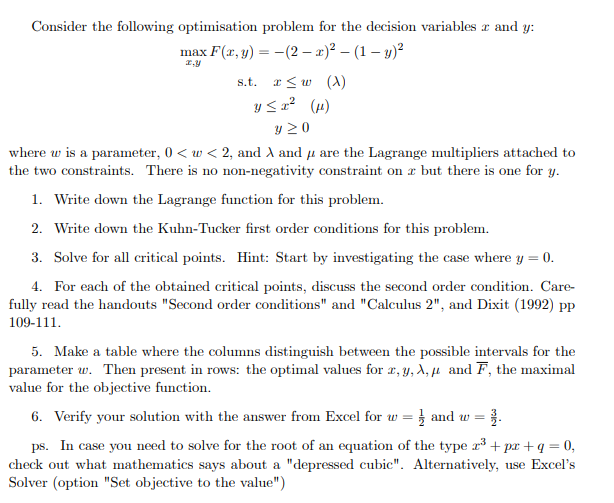
Consider the following optimisation problem for the decision variables x and y: IggFle-yl = -(2-sl2 [1 slg at. 511: {A} a 5 $2 (a) FED where to is a parameter. 0 s: to s: 2, and A and p: are the Lagrange multipliers attached to the two constraints. There is no non-negativity constraint on m but there is one for y. 1. Write down the Lagrange function for this problem. 2. Write down the Kuhn-Tucker rst order conditions for this problem. 3. Solve for all critical points. Hint: Start by investigating the case where y = . 4. For each of the obtained critical points, discuss the second order condition. Gare- fully read the handouts l"Second order conditions1II and IrCalculus 2'". and Dinit [1992] pp 109-111. 5. Make a table where the columns distinguish between the possible intervals for the parameter In. Thea present in rows: the optimal values for 133;, A, In. and F, the maximal value for the objective function. 6. Verify your solution with the answer from Excel for n: = i and n: = E. ps. In case you need to solve for the root of an equation of the type 3:3 + pa! + q = , check out what mathemics says about a \"depressed cubic". Alternatively, use Excel's Solver {option \"Set objective to the value")
Step by Step Solution
There are 3 Steps involved in it

Get step-by-step solutions from verified subject matter experts
 Study Help