


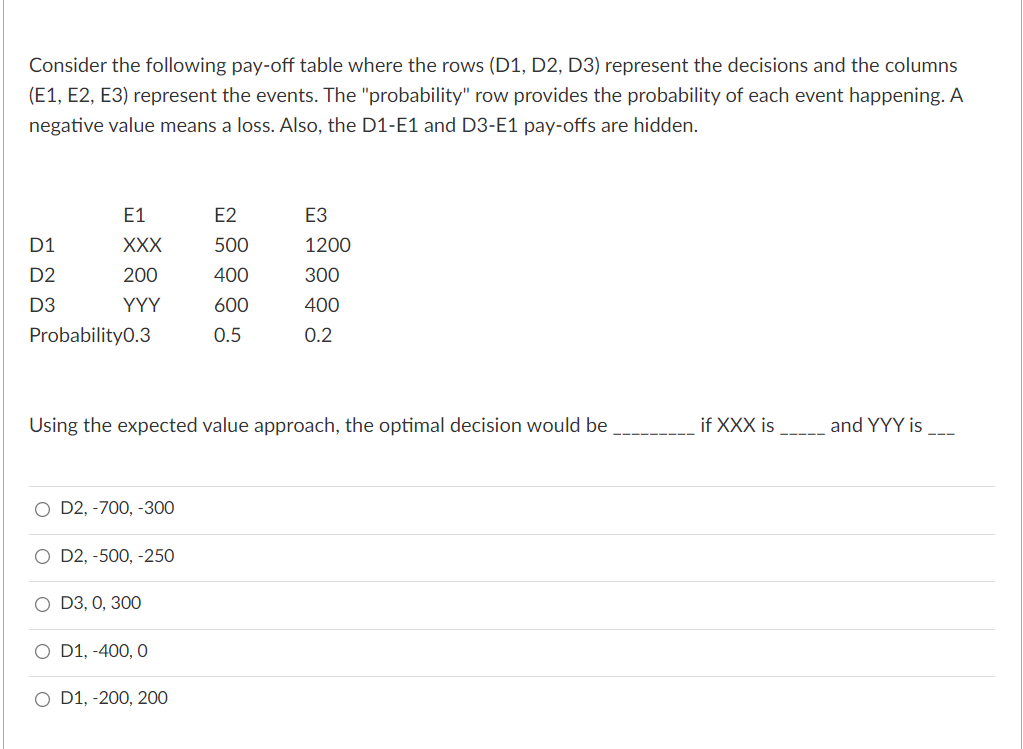
Question: Consider the following pay-off table where the rows (D1, D2, D3) represent the decisions and the columns (E1, E2, E3) represent the events. The probability
Consider the following pay-off table where the

Consider the following pay-off table where the rows (D1, D2, D3) represent the decisions and the columns (E1, E2, E3) represent the events. The "probability" row provides the probability of each event happening. A negative value means a loss. Also, the D1-E1 and D3-E1 pay-offs are hidden. Using the expected value approach, the optimal decision would be if XXX is and YYY is \begin{tabular}{l} D2, -700, -300 \\ \hline D2, -500, -250 \\ \hline D3, 0,300 \\ \hline D1, 400,0 \\ \hline D1, 200,200 \end{tabular}

Step by Step Solution

There are 3 Steps involved in it

1 Expert Approved Answer
Step: 1 Unlock blur-text-image

Question Has Been Solved by an Expert!

Get step-by-step solutions from verified subject matter experts

Step: 2 Unlock
Step: 3 Unlock

Students Have Also Explored These Related General Management Questions!