



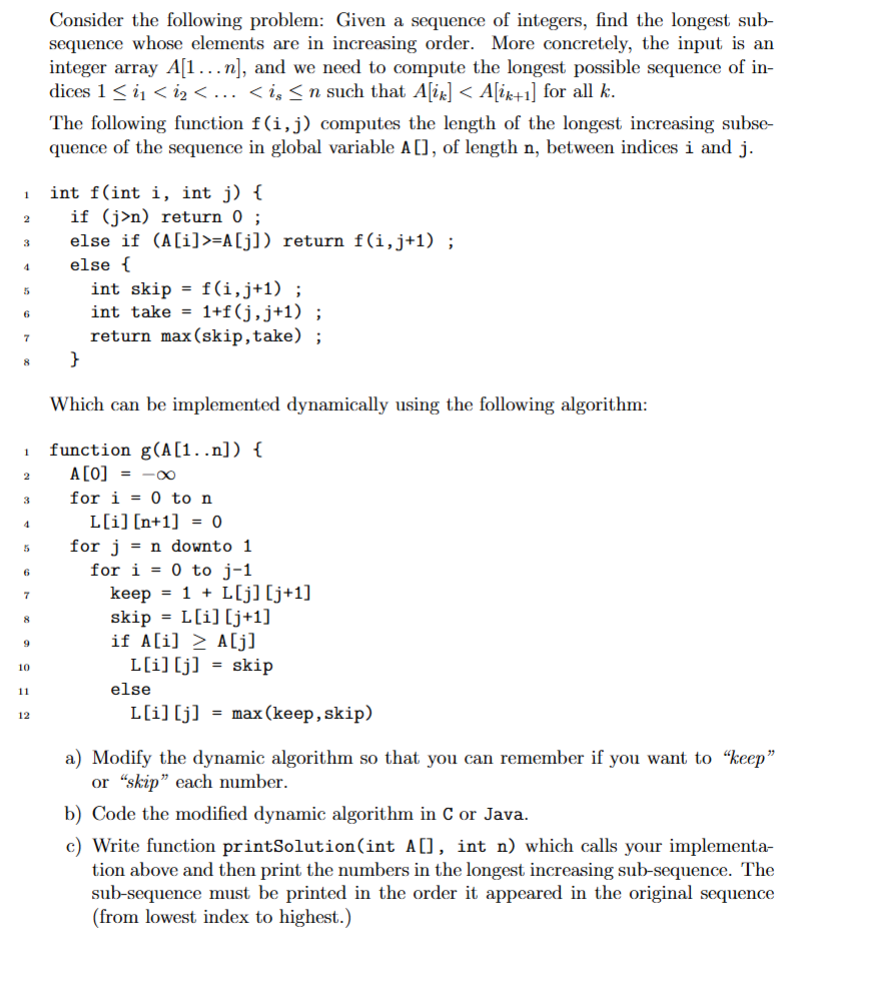
Question: Consider the following problem: Given a sequence of integers, find the longest subsequence whose elements are in increasing order. More concretely, the input is an
Consider the following problem: Given a sequence of integers, find the longest subsequence whose elements are in increasing order. More concretely, the input is an integer array Aldots n and we need to compute the longest possible sequence of indices leq in return ;
else if AiAj return fij ;
else
int skip fij ;
int take fjj ;
return maxskiptake ;
Which can be implemented dynamically using the following algorithm:
function gAn
Ainfty
for i to n
Lin
for j n downto
for i to j
keep Ljj
skip Lij
if Aigeq Aj
Lij skip
else
Lij maxkeepskip
a Modify the dynamic algorithm so that you can remember if you want to "keep" or "skip" each number.
b Code the modified dynamic algorithm in C or Java.
c Write function printSolutionint A int n which calls your implementation above and then print the numbers in the longest increasing subsequence. The subsequence must be printed in the order it appeared in the original sequence from lowest index to highest.
Step by Step Solution
There are 3 Steps involved in it
1 Expert Approved Answer
Step: 1 Unlock

Question Has Been Solved by an Expert!
Get step-by-step solutions from verified subject matter experts
Step: 2 Unlock
Step: 3 Unlock