







Question: Consider the following problem: Input: an array A with n distinct numbers, and an array B with the same n numbers in a different order
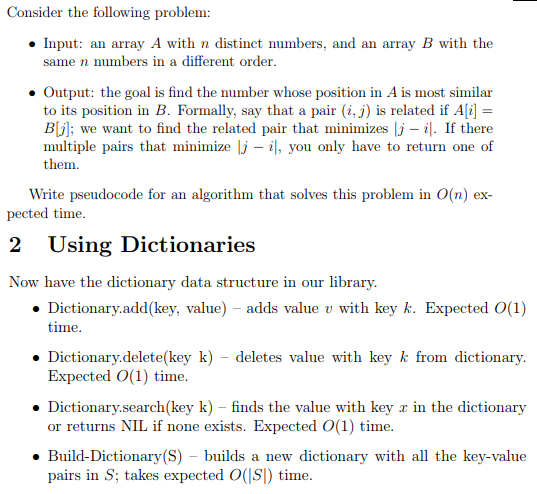
Consider the following problem: Input: an array A with n distinct numbers, and an array B with the same n numbers in a different order Output: the goal is find the number whose position in A is most similar to its position in B. Formally, say that a pair (i,j) is related if Ai- Blj: we want to find the related pair that minimizes lj-If there multiple pairs that minimize lj - il, you only have to return one of them. Write pseudocode for an algorithm that solves this problem in O(n) ex- pected time 2 Using Dictionaries Now have the dictionary data structure in our library. Dictionary.add(key, value) - adds value v with key k. Expected O(1) time Dictionary.delete(key k) deletes value with key k from dictionary Expected O(1) time . Dictionary.search(key k)-finds the value with key x in the dictionary. or returns NIL if none exists. Expected O(1) time Build-Dictionary(S) builds a new dictionary with all the key-value pairs in S; takes expected O(lSI) time Consider the following problem: Input: an array A with n distinct numbers, and an array B with the same n numbers in a different order Output: the goal is find the number whose position in A is most similar to its position in B. Formally, say that a pair (i,j) is related if Ai- Blj: we want to find the related pair that minimizes lj-If there multiple pairs that minimize lj - il, you only have to return one of them. Write pseudocode for an algorithm that solves this problem in O(n) ex- pected time 2 Using Dictionaries Now have the dictionary data structure in our library. Dictionary.add(key, value) - adds value v with key k. Expected O(1) time Dictionary.delete(key k) deletes value with key k from dictionary Expected O(1) time . Dictionary.search(key k)-finds the value with key x in the dictionary. or returns NIL if none exists. Expected O(1) time Build-Dictionary(S) builds a new dictionary with all the key-value pairs in S; takes expected O(lSI) time
Step by Step Solution
There are 3 Steps involved in it

Get step-by-step solutions from verified subject matter experts
 Study Help