







Question: Consider the following Process and Stream Table : Recirculated Air Ambient air Heater Air out 90% RH Heater Ambient air Air out 90% RH Design:
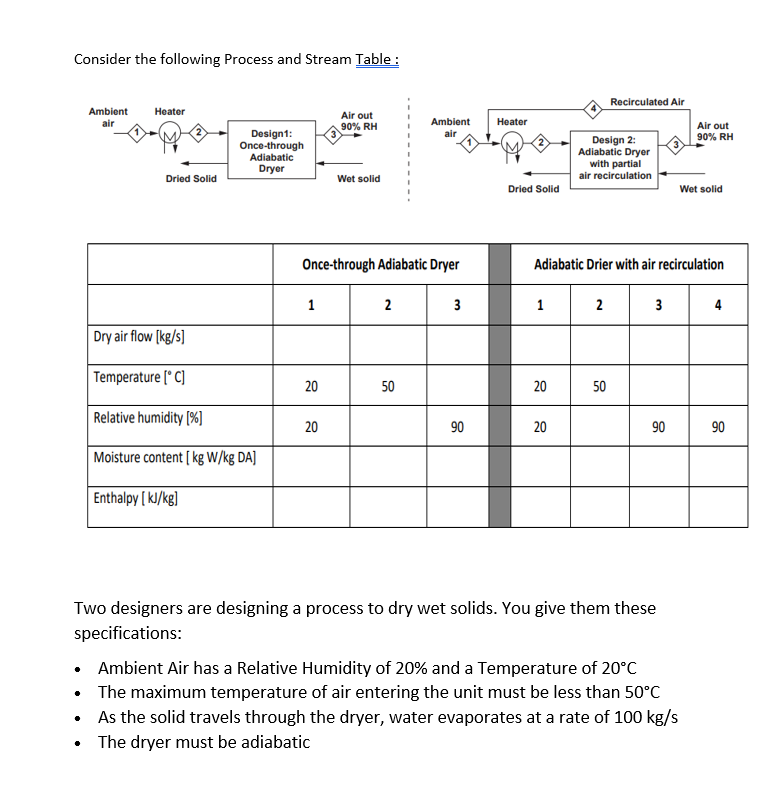
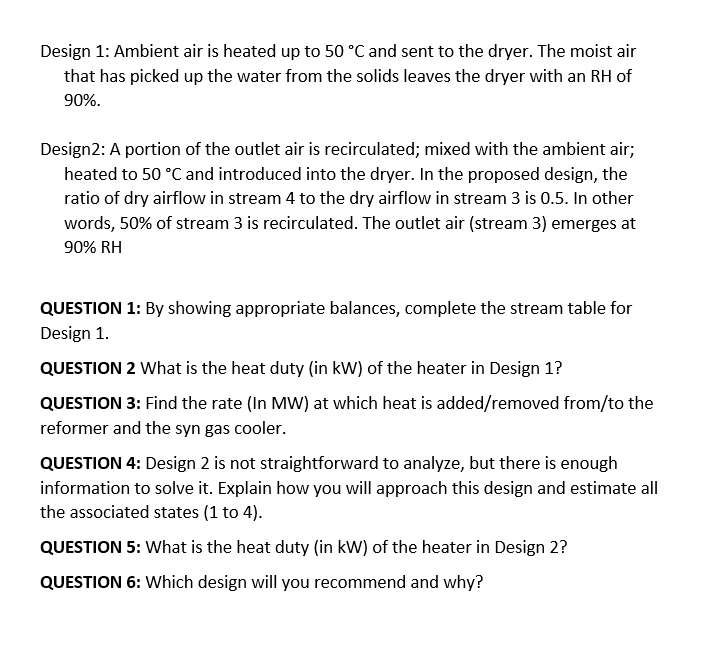
Consider the following Process and Stream Table : Recirculated Air Ambient air Heater Air out 90% RH Heater Ambient air Air out 90% RH Design: Once through Adiabatic Dryer Design 2: Adiabatic Dryer with partial air recirculation Dried Solid Wet solid Dried Solid Wet solid Once-through Adiabatic Dryer Adiabatic Drier with air recirculation 1 2 3 1 2 3 4 Dry air flow [kg/s] Temperature ( C) 20 50 20 50 Relative humidity (%) 20 90 20 90 90 Moisture content [kg W/kg DA] Enthalpy (kJ/kg) . Two designers are designing a process to dry wet solids. You give them these specifications: Ambient Air has a Relative Humidity of 20% and a Temperature of 20C The maximum temperature of air entering the unit must be less than 50C As the solid travels through the dryer, water evaporates at a rate of 100 kg/s The dryer must be adiabatic . Design 1: Ambient air is heated up to 50 C and sent to the dryer. The moist air that has picked up the water from the solids leaves the dryer with an RH of 90%. Design2: A portion of the outlet air is recirculated; mixed with the ambient air; heated to 50 C and introduced into the dryer. In the proposed design, the ratio of dry airflow in stream 4 to the dry airflow in stream 3 is 0.5. In other words, 50% of stream 3 is recirculated. The outlet air (stream 3) emerges at 90% RH QUESTION 1: By showing appropriate balances, complete the stream table for Design 1. QUESTION 2 What is the heat duty (in kW) of the heater in Design 1? QUESTION 3: Find the rate (In MW) at which heat is added/removed from/to the reformer and the syn gas cooler. QUESTION 4: Design 2 is not straightforward to analyze, but there is enough information to solve it. Explain how you will approach this design and estimate all the associated states (1 to 4). QUESTION 5: What is the heat duty (in kW) of the heater in Design 2? QUESTION 6: Which design will you recommend and why
Step by Step Solution
There are 3 Steps involved in it

Get step-by-step solutions from verified subject matter experts
 Study Help