







Question: Consider the following process. Assume that task 1 takes 6 minutes. What is the rush order flow time in this process? 2. Which of the
Consider the following process. Assume that task 1 takes 6 minutes. What is the rush order flow time in this process?
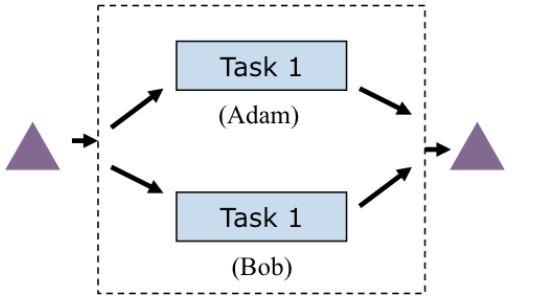
2.
Which of the following statements is true?
| Service and production systems with variability cannot operate at their theoretical capacity | ||
| If the process has variability, and the demand rate is equal to its capacity, the utilization will be higher than 100% | ||
| A process with variability can never have a utilization higher than 80% | ||
| For a process with variability, an increase in coefficient of variation for processing times, other things equal, will lead to decrease of average waiting time. |
3.
Which of the following statements is NOT true about the process with variability?
| In a demand constrained process, an increase of the average inter-arrival time will lead to a decrease of the average waiting time. | ||
| If a process is capacity constrained, in a long run all servers will be busy 100% of the time | ||
| For most service systems, aiming for a 80% utilization is a good rule of thumb to keep the waiting time in check. | ||
| If a process is demand constrained, the average number of flow units (or customers) being processed will be equal to the number of servers (i.e., Ip = m) |
4.
The Dynac Manufacturing Company produces a particular product in an assembly line operation. One of the machines on the line is a drill press that has a single assembly line feeding into it. Partially complete units arrive at the press at a rate of 30 units per hour, and at any given time there is an average of 8 units at this work station. What is the average time a unit spends at the drill press station? Express your answer in minutes, round to two decimals of needed.
Task 1 (Adam) Task 1 (Bob)Step by Step Solution
There are 3 Steps involved in it

Get step-by-step solutions from verified subject matter experts
 Study Help