







Question: Consider the following process. You start with a unit square. Next, you put a second unit square next to the first so that the two
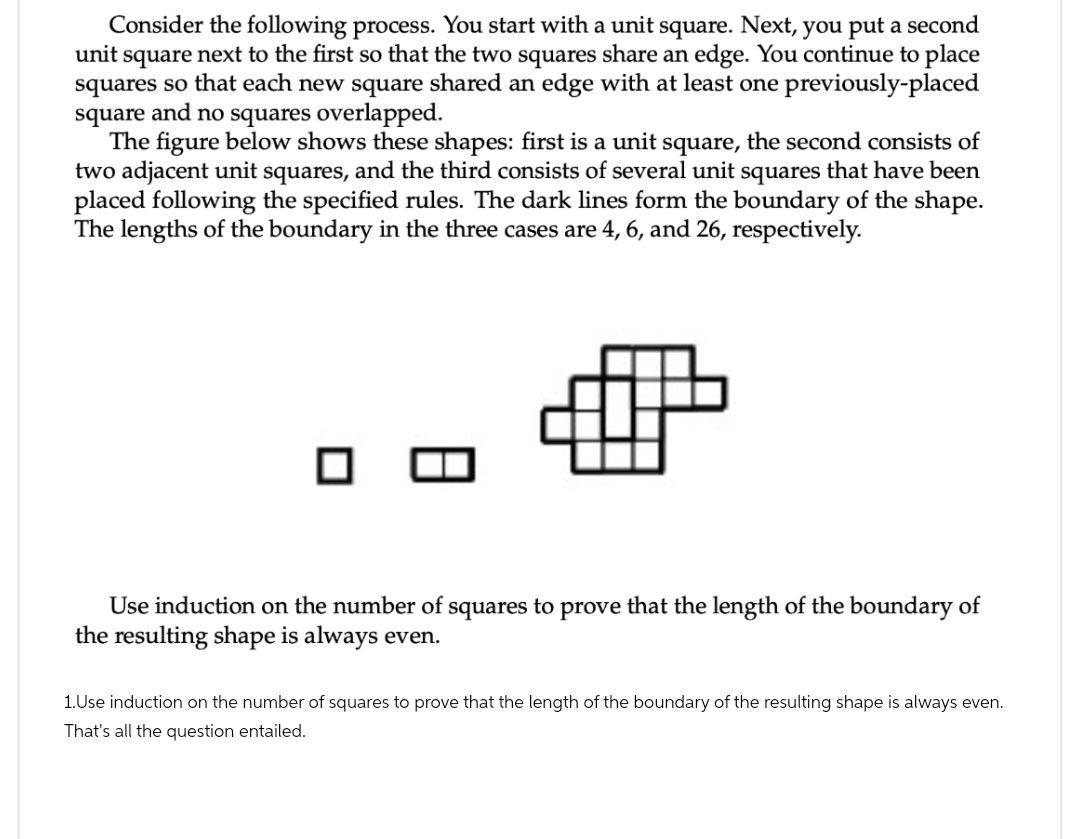
Consider the following process. You start with a unit square. Next, you put a second unit square next to the first so that the two squares share an edge. You continue to place squares so that each new square shared an edge with at least one previously-placed square and no squares overlapped. The figure below shows these shapes: first is a unit square, the second consists of two adjacent unit squares, and the third consists of several unit squares that have been placed following the specified rules. The dark lines form the boundary of the shape. The lengths of the boundary in the three cases are 4, 6, and 26, respectively. D Use induction on the number of squares to prove that the length of the boundary of the resulting shape is always even. 1.Use induction on the number of squares to prove that the length of the boundary of the resulting shape is always even. That's all the question entailed. Consider the following process. You start with a unit square. Next, you put a second unit square next to the first so that the two squares share an edge. You continue to place squares so that each new square shared an edge with at least one previously-placed square and no squares overlapped. The figure below shows these shapes: first is a unit square, the second consists of two adjacent unit squares, and the third consists of several unit squares that have been placed following the specified rules. The dark lines form the boundary of the shape. The lengths of the boundary in the three cases are 4, 6, and 26, respectively. D Use induction on the number of squares to prove that the length of the boundary of the resulting shape is always even. 1.Use induction on the number of squares to prove that the length of the boundary of the resulting shape is always even. That's all the question entailed
Step by Step Solution
There are 3 Steps involved in it

Get step-by-step solutions from verified subject matter experts
 Study Help