







Question: Consider the following program in C-like syntax int fun (int i) { *1 += 5; return 2; } void main() { int x =
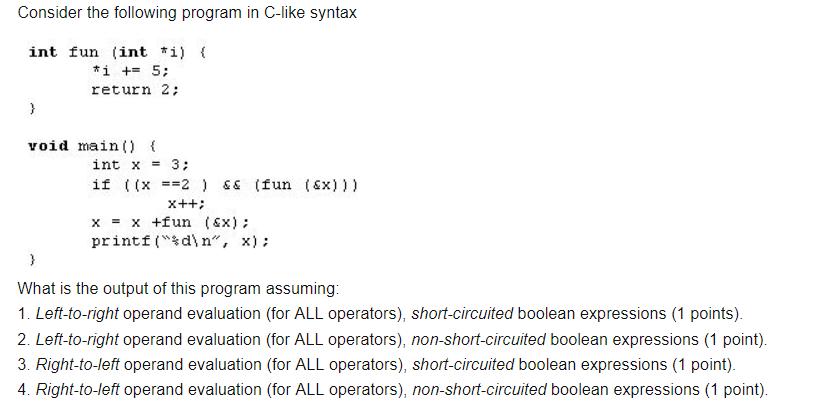
Consider the following program in C-like syntax int fun (int i) { *1 += 5; return 2; } void main() { int x = 3; if ((x==2 ) && (fun (Ex) ) ) x++; x = x +fun (&x); printf("d ", x); } What is the output of this program assuming: 1. Left-to-right operand evaluation (for ALL operators), short-circuited boolean expressions (1 points). 2. Left-to-right operand evaluation (for ALL operators), non-short-circuited boolean expressions (1 point). 3. Right-to-left operand evaluation (for ALL operators), short-circuited boolean expressions (1 point). 4. Right-to-left operand evaluation (for ALL operators), non-short-circuited boolean expressions (1 point).
Step by Step Solution
There are 3 Steps involved in it
1 Lefttoright operand evaluation shortcircuited boolean expressions In this case the shortcircuit be... View full answer

Get step-by-step solutions from verified subject matter experts
 Study Help