







Question: Consider the following program specification: nput: An integer n>O and an array A[O. (n-1)] of n integers. Output: The smallest index s such that A[s]
![array A[O. (n-1)] of n integers. Output: The smallest index s such](https://dsd5zvtm8ll6.cloudfront.net/si.experts.images/questions/2024/09/66f3b682663f6_00266f3b68208ee9.jpg)
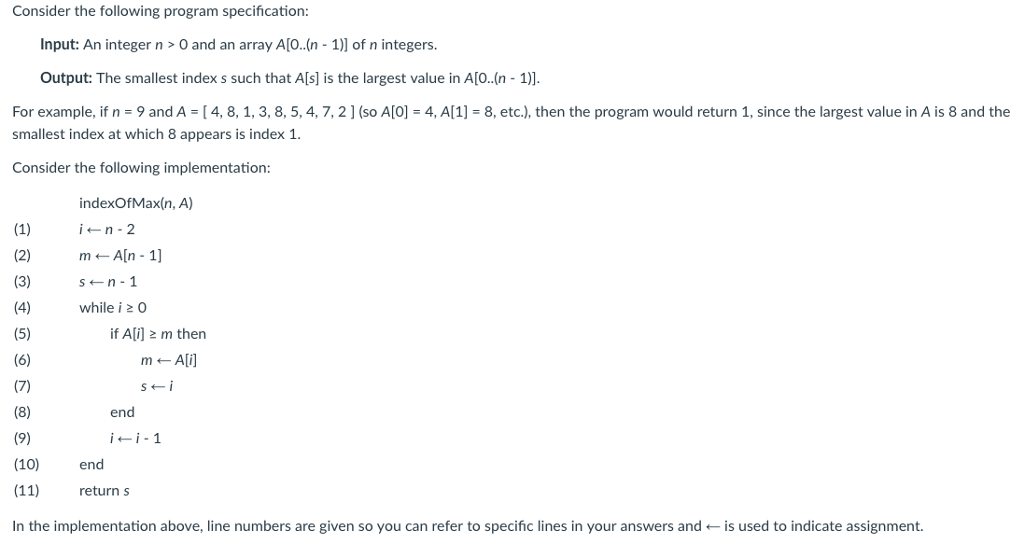
Consider the following program specification: nput: An integer n>O and an array A[O. (n-1)] of n integers. Output: The smallest index s such that A[s] is the largest value in A[O..(n 1) For example, if n = 9 and A-| 4, 8, 1, 3, 8, 5.4, 7, 2 ] (so A[O-4, A[1]-8, etc.), then the program would return 1, since the largest value in A is 8 and the smallest index at which 8 appears is index 1. Consider the following implementation: indexOfMax(n, A) (2) mAln-1] (3) n-1 (4) while i 2 0 if Ai] 2 m then m-Al s-i end (10) end (11) returns In the implementation above, line numbers are given so you can refer to specific lines in your answers and is used to indicate assignment. Consider the following program specification: nput: An integer n>O and an array A[O. (n-1)] of n integers. Output: The smallest index s such that A[s] is the largest value in A[O..(n 1) For example, if n = 9 and A-| 4, 8, 1, 3, 8, 5.4, 7, 2 ] (so A[O-4, A[1]-8, etc.), then the program would return 1, since the largest value in A is 8 and the smallest index at which 8 appears is index 1. Consider the following implementation: indexOfMax(n, A) (2) mAln-1] (3) n-1 (4) while i 2 0 if Ai] 2 m then m-Al s-i end (10) end (11) returns In the implementation above, line numbers are given so you can refer to specific lines in your answers and is used to indicate assignment
Step by Step Solution
There are 3 Steps involved in it

Get step-by-step solutions from verified subject matter experts
 Study Help