







Question: Consider the following proposal for a cryptographic hash function, that makes use of a block cipher E with block size k bits to produce k
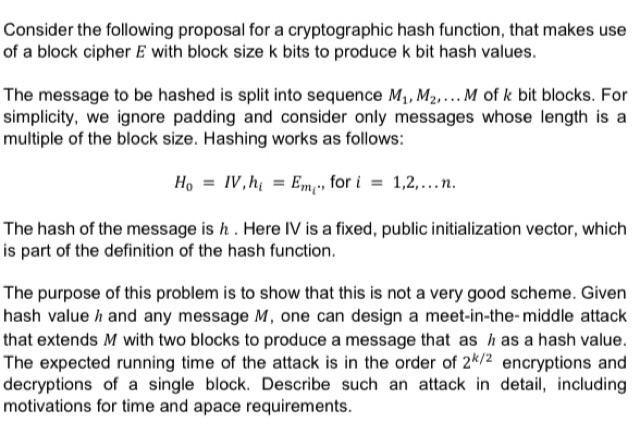
Consider the following proposal for a cryptographic hash function, that makes use of a block cipher E with block size k bits to produce k bit hash values. The message to be hashed is split into sequence M, M2.... M of k bit blocks. For simplicity, we ignore padding and consider only messages whose length is a multiple of the block size. Hashing works as follows: H= IV, hi = Em., for i = 1,2,...n. The hash of the message is h . Here IV is a fixed, public initialization vector, which is part of the definition of the hash function. The purpose of this problem is to show that this is not a very good scheme. Given hash value h and any message M, one can design a meet-in-the-middle attack that extends M with two blocks to produce a message that as has a hash value. The expected running time of the attack is in the order of 2k/2 encryptions and decryptions of a single block. Describe such an attack in detail, including motivations for time and apace requirements
Step by Step Solution
There are 3 Steps involved in it

Get step-by-step solutions from verified subject matter experts
 Study Help