







Question: Consider the following pseudocode: int x = 0 set_x (int n) { x = n } print_x() { print(x) } f() { set_x(1); print_x()
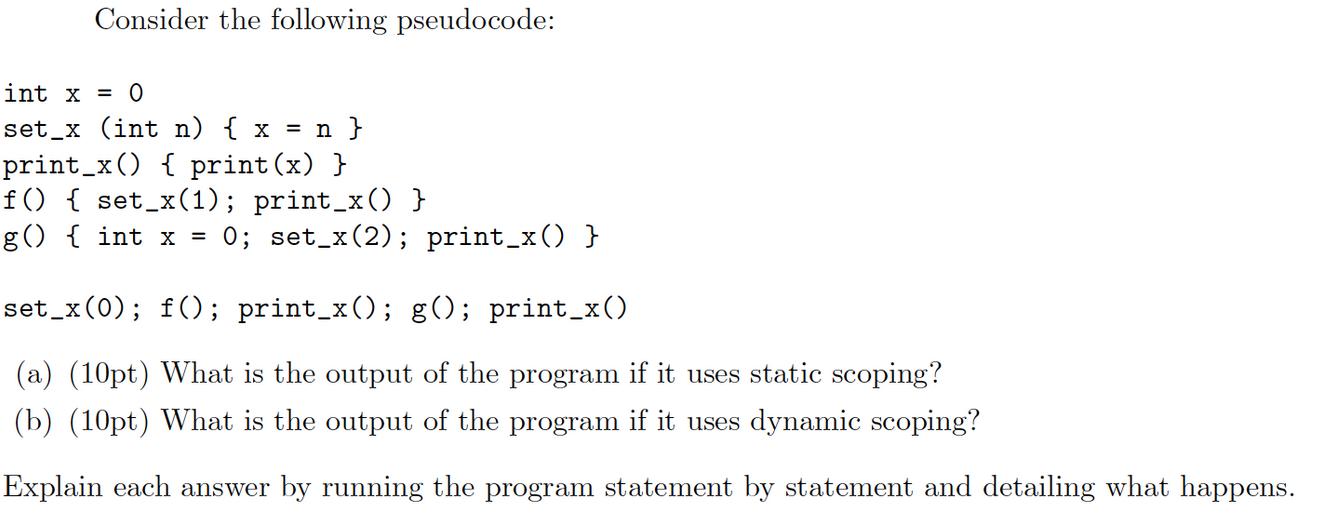
Consider the following pseudocode: int x = 0 set_x (int n) { x = n } print_x() { print(x) } f() { set_x(1); print_x() } g() { int x = 0; set_x(2); print_x() } set_x(0); f(); print_x()%; g(); print_x() (a) (10pt) What is the output of the program if it uses static scoping? (b) (10pt) What is the output of the program if it uses dynamic scoping? Explain each answer by running the program statement by statement and detailing what happens.
Step by Step Solution
There are 3 Steps involved in it
Lets analyze the given pseudocode and determine the output for both static scoping and dynamic scoping Static Scoping In static scoping also known as lexical scoping the scope of a variable is determi... View full answer

Get step-by-step solutions from verified subject matter experts
 Study Help