



Question: Consider the following relation and query: Relation: B(bid, accNo), accNo is a key. A(accNo, code, balance), accNo is a key. Query: SELECT B.bid, Sum(A.balance) FROM
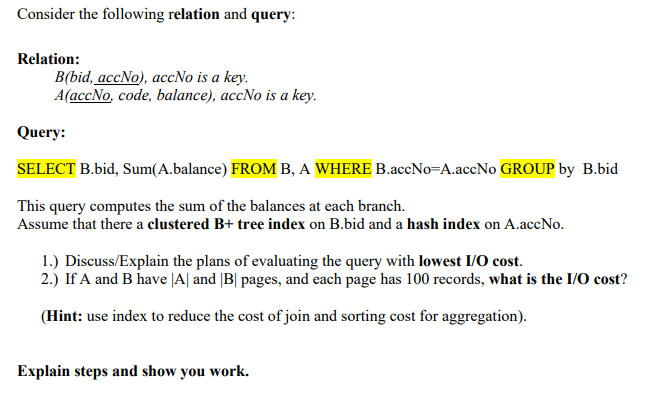
Consider the following relation and query: Relation: B(bid, accNo), accNo is a key. A(accNo, code, balance), accNo is a key. Query: SELECT B.bid, Sum(A.balance) FROM B, A WHERE B.accNo=A.accNo GROUP by B.bid This query computes the sum of the balances at each branch. Assume that there a clustered B+ tree index on B.bid and a hash index on A.accNo. 1.) Discuss/Explain the plans of evaluating the query with lowest I/O cost. 2.) If A and B have A and (B| pages, and each page has 100 records, what is the I/O cost? (Hint: use index to reduce the cost of join and sorting cost for aggregation). Explain steps and show you work. Consider the following relation and query: Relation: B(bid, accNo), accNo is a key. A(accNo, code, balance), accNo is a key. Query: SELECT B.bid, Sum(A.balance) FROM B, A WHERE B.accNo=A.accNo GROUP by B.bid This query computes the sum of the balances at each branch. Assume that there a clustered B+ tree index on B.bid and a hash index on A.accNo. 1.) Discuss/Explain the plans of evaluating the query with lowest I/O cost. 2.) If A and B have A and (B| pages, and each page has 100 records, what is the I/O cost? (Hint: use index to reduce the cost of join and sorting cost for aggregation). Explain steps and show you work
Step by Step Solution
There are 3 Steps involved in it

Get step-by-step solutions from verified subject matter experts