







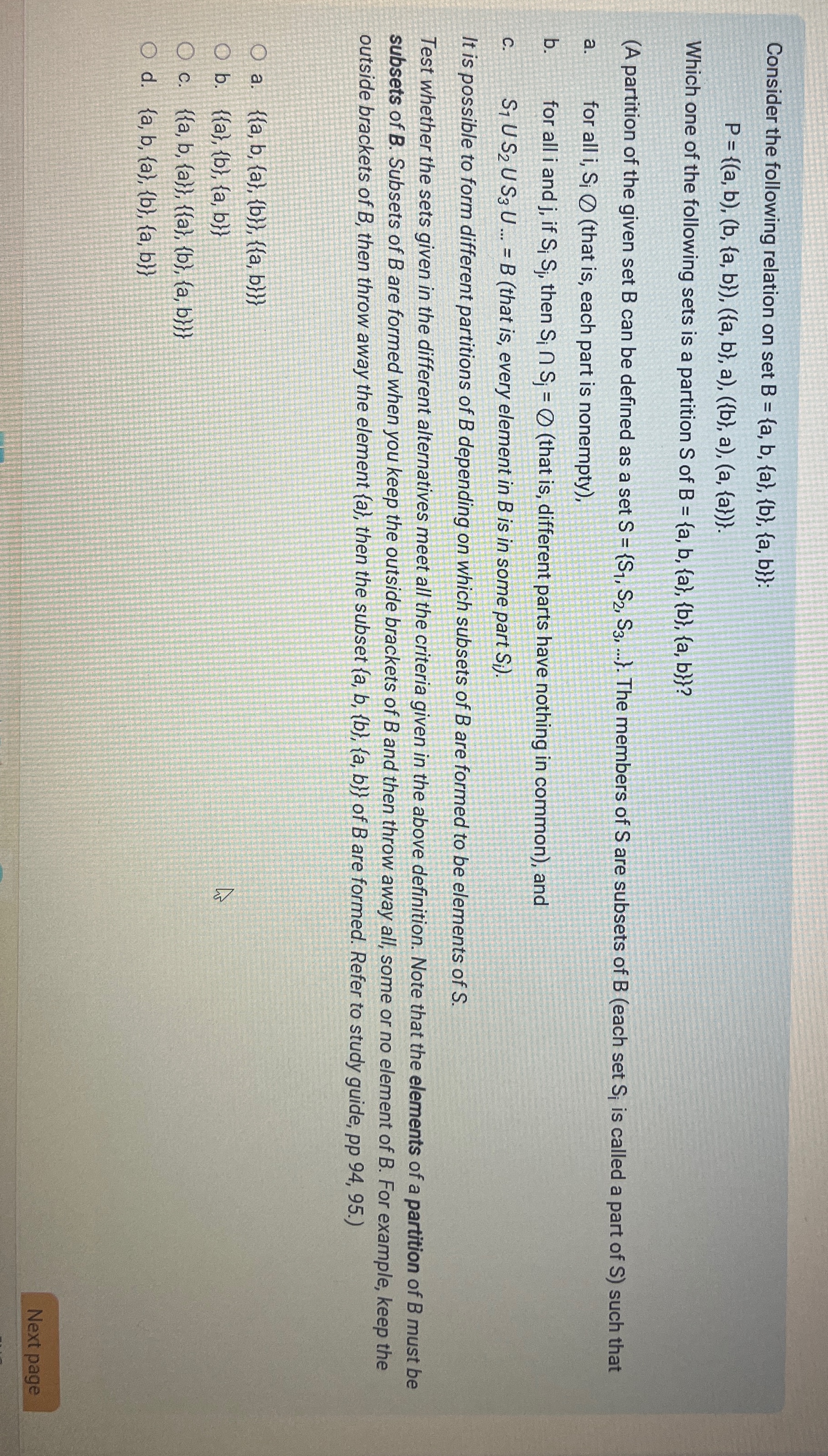
Question: Consider the following relation on set B = { a , b , { a } , { b } , { a , b
Consider the following relation on set :
Which one of the following sets is a partition of
A partition of the given set can be defined as a set dots The members of are subsets of each set is called a part of such that
a for all that is each part is nonempty
b for all i and if then that is different parts have nothing in common and
cdotsthat is every element in is in some part
It is possible to form different partitions of depending on which subsets of are formed to be elements of
Test whether the sets given in the different alternatives meet all the criteria given in the above definition. Note that the elements of a partition of must be subsets of Subsets of are formed when you keep the outside brackets of and then throw away all, some or no element of For example, keep the outside brackets of then throw away the element then the subset of are formed. Refer to study guide, pp
a
b
c
d
Step by Step Solution
There are 3 Steps involved in it
1 Expert Approved Answer
Step: 1 Unlock

Question Has Been Solved by an Expert!
Get step-by-step solutions from verified subject matter experts
Step: 2 Unlock
Step: 3 Unlock
 Study Help