







Question: Consider the following relational database schema: Author ( aID , aName, age, nationality ) Publisher ( pID , pName, address ) PublishesWith ( aID ,
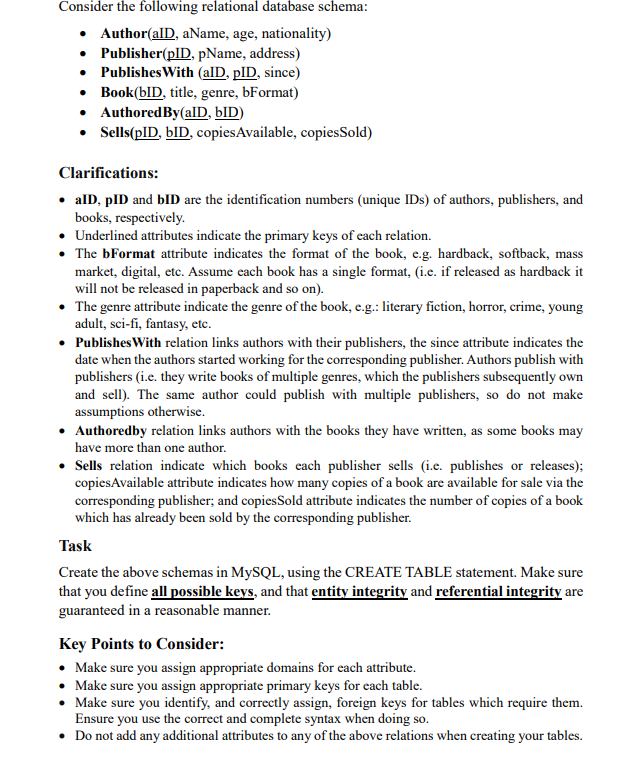
Consider the following relational database schema: AuthoraID aName, age, nationality PublisherpID pName, address PublishesWith aID pID, since BookbID title, genre, bFormat AuthoredByaID bID SellspID bID, copiesAvailable, copiesSold Clarifications: aID, pID and bID are the identification numbers unique IDs of authors, publishers, and books, respectively. Underlined attributes indicate the primary keys of each relation. The bFormat attribute indicates the format of the book, eg hardback, softback, mass market, digital, etc. Assume each book has a single format, ie if released as hardback it will not be released in paperback and so on The genre attribute indicate the genre of the book, eg: literary fiction, horror, crime, young adult, scifi fantasy, etc. PublishesWith relation links authors with their publishers, the since attribute indicates the date when the authors started working for the corresponding publisher. Authors publish with publishers ie they write books of multiple genres, which the publishers subsequently own and sell The same author could publish with multiple publishers, so do not make assumptions otherwise. Authoredby relation links authors with the books they have written, as some books may have more than one author. Sells relation indicate which books each publisher sells ie publishes or releases; copiesAvailable attribute indicates how many copies of a book are available for sale via the corresponding publisher; and copiesSold attribute indicates the number of copies of a book which has already been sold by the corresponding publisher. Task Create the above schemas in MySQL using the CREATE TABLE statement. Make sure that you define all possible keys, and that entity integrity and referential integrity are guaranteed in a reasonable manner. Key Points to Consider: Make sure you assign appropriate domains for each attribute. Make sure you assign appropriate primary keys for each table. Make sure you identify, and correctly assign, foreign keys for tables which require them. Ensure you use the correct and complete syntax when doing so Do not add any additional attributes to any of the above relations when creating your tables Consider the following relational database schema:
AuthoraID aName, age, nationality
PublisherpID pName, address
PublishesWith aID pID, since
BookbID title, genre, bFormat
AuthoredByaID bID
SellspID bID, copiesAvailable, copiesSold
Clarifications:
aID, pID and bID are the identification numbers unique IDs of authors, publishers, and books, respectively.
Underlined attributes indicate the primary keys of each relation.
The bFormat attribute indicates the format of the book, eg hardback, softback, mass market, digital, etc. Assume each book has a single format, ie if released as hardback it will not be released in paperback and so on
The genre attribute indicate the genre of the book, eg: literary fiction, horror, crime, young adult, scifi fantasy, etc.
PublishesWith relation links authors with their publishers, the since attribute indicates the date when the authors started working for the corresponding publisher. Authors publish with publishers ie they write books of multiple genres, which the publishers subsequently own and sell The same author could publish with multiple publishers, so do not make assumptions otherwise.
Authoredby relation links authors with the books they have written, as some books may have more than one author.
Sells relation indicate which books each publisher sells ie publishes or releases; copiesAvailable attribute indicates how many copies of a book are available for sale via the corresponding publisher; and copiesSold attribute indicates the number of copies of a book which has already been sold by the corresponding publisher.
Task
Create the above schemas in MySQL using the CREATE TABLE statement. Make sure that you define all possible keys, and that entity integrity and referential integrity are guaranteed in a reasonable manner.
Key Points to Consider:
Make sure you assign appropriate domains for each attribute.
Make sure you assign appropriate primary keys for each table.
Make sure you identify, and correctly assign, foreign keys for tables which require them. Ensure you use the correct and complete syntax when doing so
Do not add any additional attributes to any of the above relations when creating your tables.
Step by Step Solution
There are 3 Steps involved in it
1 Expert Approved Answer
Step: 1 Unlock

Question Has Been Solved by an Expert!
Get step-by-step solutions from verified subject matter experts
Step: 2 Unlock
Step: 3 Unlock
 Study Help