







Question: Consider the following resource allocation graph, defined as in section 7.2.2 G = (P, R, E), P = (P1, P2, P3), R = (R1, R2,
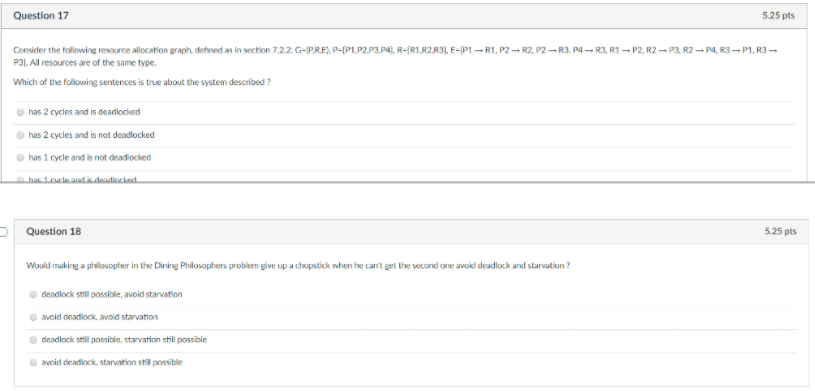
Consider the following resource allocation graph, defined as in section 7.2.2 G = (P, R, E), P = (P1, P2, P3), R = (R1, R2, R3), E = (P1 rightarrow R_1, P2 rightarrow R2, P2 rightarrow R3, P4 rightarrow R3, R1 rightarrow P2, R2 rightarrow P3, R2 rightarrow P4, R3 rightarrow P1, R3 rightarrow P3). All resources are of the same type. Which of the following sentences is true about the system described ? has 2 cycles and is deadlocked has 2 cycles is not deadlocked has 1 cycle and is not deadlocked has 1 cycle and is deadlock. Would making a philosopher in the Dining Philosophers problem give up a chopstick when he can't get the second one avoid deadlock and starvation? deadlock still possible, avoid starvation avoid deadlock, avoid starvation deadlock still possible, starvation still possible avoid deadlock, starvation still possible
Step by Step Solution
There are 3 Steps involved in it

Get step-by-step solutions from verified subject matter experts
 Study Help